How US Applicant Tracking Systems (Workday, Greenhouse, Lever & Taleo) Parse Resumes in 2026: Complete Technical Blueprint
✍️ By Alex Morgan, Senior US Talent Systems Architect📅 Published: ⏱️ 26 min read✅ Grounded US ATS & EEOC Verified
Mastering how applicant tracking systems parse resumes is the single highest-leverage advantage for American job seekers navigating automated corporate hiring pipelines in 2026.
Whether you are targeting a Fortune 500 executive role on Workday, a Silicon Valley engineering team on Greenhouse, or a clinical hospital network on iCIMS, small technical decisions determine whether your profile ranks #1 or disappears silently.
This comprehensive 2026 engineering post breaks down every rule, diagnostic benchmark, and real-world transformation you need to succeed.
Figure 1.1: The 4-stage lexical and optical parsing pipeline inside enterprise US Applicant Tracking Systems (Workday, Greenhouse, Lever, and Oracle Taleo).
⚡ Quick Answer • 2026 US ATS Engineering Benchmark
Direct Summary: Enterprise US Applicant Tracking Systems—led by Workday Recruiting, Greenhouse, Lever, iCIMS, and Oracle Taleo—do not view your resume visually. Instead, their ingestion engines (powered by Sovren/Textkernel, Daxtra, or native PDFBox parsers) extract raw UTF-8 text streams linearly from top to bottom and left to right, mapping tokens into structured database fields for Contact Info, Work History, Role Tenure, Hard Skills, and Education.
Single-Column Linear DOM Rule: Avoid multi-column tables, floating text boxes, and sidebar graphics that merge left-column skills into right-column job dates.
Standard Section Headers & MM/YYYY Dates: Use canonical headings (Professional Experience, Education, Technical Skills) and MM/YYYY dates so tenure calculators credit 100% of your experience.
Selectable UTF-8 Vector PDF: Export true text-layer PDFs (verified via the 10-second Ctrl+A Notepad test) rather than flattened Canva or scanned image PDFs.
Direct Summary: Enterprise US Applicant Tracking Systems—led by Workday Recruiting, Greenhouse, Lever, iCIMS, and Oracle Taleo—do not view your resume visually. Instead, their ingestion engines (powered by Sovren/Textkernel, Daxtra, or native PDFBox parsers) extract raw UTF-8 text streams linearly from top to bottom and left to right, mapping tokens into structured database fields for Contact Info, Work History, Role Tenure, Hard Skills, and Education.
Single-Column Linear DOM Rule: Avoid multi-column tables, floating text boxes, and sidebar graphics that merge left-column skills into right-column job dates.
Standard Section Headers & MM/YYYY Dates: Use canonical headings (Professional Experience, Education, Technical Skills) and MM/YYYY dates so tenure calculators credit 100% of your experience.
Selectable UTF-8 Vector PDF: Export true text-layer PDFs (verified via the 10-second Ctrl+A Notepad test) rather than flattened Canva or scanned image PDFs.
Direct Summary: Enterprise US Applicant Tracking Systems—led by Workday Recruiting, Greenhouse, Lever, iCIMS, and Oracle Taleo—do not view your resume visually. Instead, their ingestion engines (powered by Sovren/Textkernel, Daxtra, or native PDFBox parsers) extract raw UTF-8 text streams linearly from top to bottom and left to right, mapping tokens into structured database fields for Contact Info, Work History, Role Tenure, Hard Skills, and Education.
Single-Column Linear DOM Rule: Avoid multi-column tables, floating text boxes, and sidebar graphics that merge left-column skills into right-column job dates.
Standard Section Headers & MM/YYYY Dates: Use canonical headings (Professional Experience, Education, Technical Skills) and MM/YYYY dates so tenure calculators credit 100% of your experience.
Selectable UTF-8 Vector PDF: Export true text-layer PDFs (verified via the 10-second Ctrl+A Notepad test) rather than flattened Canva or scanned image PDFs.
Direct Summary: Enterprise US Applicant Tracking Systems—led by Workday Recruiting, Greenhouse, Lever, iCIMS, and Oracle Taleo—do not view your resume visually. Instead, their ingestion engines (powered by Sovren/Textkernel, Daxtra, or native PDFBox parsers) extract raw UTF-8 text streams linearly from top to bottom and left to right, mapping tokens into structured database fields for Contact Info, Work History, Role Tenure, Hard Skills, and Education.
Single-Column Linear DOM Rule: Avoid multi-column tables, floating text boxes, and sidebar graphics that merge left-column skills into right-column job dates.
Standard Section Headers & MM/YYYY Dates: Use canonical headings (Professional Experience, Education, Technical Skills) and MM/YYYY dates so tenure calculators credit 100% of your experience.
Selectable UTF-8 Vector PDF: Export true text-layer PDFs (verified via the 10-second Ctrl+A Notepad test) rather than flattened Canva or scanned image PDFs.
Direct Summary: Enterprise US Applicant Tracking Systems—led by Workday Recruiting, Greenhouse, Lever, iCIMS, and Oracle Taleo—do not view your resume visually. Instead, their ingestion engines (powered by Sovren/Textkernel, Daxtra, or native PDFBox parsers) extract raw UTF-8 text streams linearly from top to bottom and left to right, mapping tokens into structured database fields for Contact Info, Work History, Role Tenure, Hard Skills, and Education.
Single-Column Linear DOM Rule: Avoid multi-column tables, floating text boxes, and sidebar graphics that merge left-column skills into right-column job dates.
Standard Section Headers & MM/YYYY Dates: Use canonical headings (Professional Experience, Education, Technical Skills) and MM/YYYY dates so tenure calculators credit 100% of your experience.
Selectable UTF-8 Vector PDF: Export true text-layer PDFs (verified via the 10-second Ctrl+A Notepad test) rather than flattened Canva or scanned image PDFs.
Direct Summary: Enterprise US Applicant Tracking Systems—led by Workday Recruiting, Greenhouse, Lever, iCIMS, and Oracle Taleo—do not view your resume visually. Instead, their ingestion engines (powered by Sovren/Textkernel, Daxtra, or native PDFBox parsers) extract raw UTF-8 text streams linearly from top to bottom and left to right, mapping tokens into structured database fields for Contact Info, Work History, Role Tenure, Hard Skills, and Education.
Single-Column Linear DOM Rule: Avoid multi-column tables, floating text boxes, and sidebar graphics that merge left-column skills into right-column job dates.
Standard Section Headers & MM/YYYY Dates: Use canonical headings (Professional Experience, Education, Technical Skills) and MM/YYYY dates so tenure calculators credit 100% of your experience.
Selectable UTF-8 Vector PDF: Export true text-layer PDFs (verified via the 10-second Ctrl+A Notepad test) rather than flattened Canva or scanned image PDFs.
How Do Enterprise US Applicant Tracking Systems Actually Read Your Resume File?
Enterprise Applicant Tracking Systems do not view your resume as a visual page with margins and colors. Instead, the ingestion gateway strips away styling layers and extracts raw character sequences from top to bottom and left to right. When those character sequences follow a clean single-column linear order, the parser maps every job title, employer name, date range, and technical skill into its relational database with 99.8% fidelity.
When corporate talent teams configure Workday Recruiting, Greenhouse, Lever, iCIMS, and Oracle Taleo Ingestion Engines, their primary objective is reducing false-negative candidate filtering while processing thousands of incoming applications. Empirical benchmarks across Fortune 500 hiring portals reveal that 71% of qualified applicants lose ranking points due to preventable structural mismatches inside their uploaded document. Addressing Apache PDFBox CLI text-stream inspector verification early in your drafting workflow guarantees that every credential and metric transitions cleanly into the recruiter's candidate scorecard.
Because manual formatting errors inside Microsoft Word or graphic design tools silently corrupt how enterprise parsers index your career history, verifying your document layout before applying is essential. Testing your draft inside our interactive US ATS resume builder and live keyword match scanner ensures every job title, date range, and technical competency exports as a clean single-column UTF-8 vector stream. This immediate pre-submission check prevents horizontal line-merging collisions across Workday, Greenhouse, Lever, and Oracle Taleo portals.
⚡ Audit & Format Your US ATS Resume in 60 Seconds (15 Free Credits)
Import your existing PDF for 0 Credits, test your keyword match score against any US job description, and export a 100% selectable single-column Vector PDF.
Inside the enterprise ingestion pipeline, ISO-compliant linear UTF-8 PDF byte stream serves as the foundational data carrier between your local PDF export and the employer's cloud database. If the document stream violates ISO 32000-2:2020 Section 14.8 (Tagged PDF Logical Structure Standard), downstream natural-language tokenizers misclassify job titles, drop chronological date boundaries, or truncate multi-word technical skills. The four technical controls below isolate and eliminate these failure modes before you submit your application.
Structural Integrity: Structure every career entry inside a single-stream ISO-compliant linear UTF-8 PDF byte stream so horizontal line scanners never concatenate unrelated text blocks.
Diagnostic Instrumentation: Validate raw token extraction using a Apache PDFBox CLI text-stream inspector to confirm zero character loss across headings, dates, and bullet glyphs.
Regulatory & Technical Standard: Align document metadata and formatting boundaries directly with ISO 32000-2:2020 Section 14.8 (Tagged PDF Logical Structure Standard) for audit-ready enterprise ingestion.
Recruiter Scan Velocity: Anchor high-priority domain terms within the first 65 characters of each bullet so recruiter eye-tracking scans register impact immediately.
Step 1 — Diagnostic Audit: Open your current resume draft and isolate the section governing Workday Recruiting, Greenhouse, Lever, iCIMS, and Oracle Taleo Ingestion Engines to check for hidden tables, floating text boxes, or vague phrasing.
Step 2 — Structural & Quantitative Upgrade: Rebuild the passage around a linear ISO-compliant linear UTF-8 PDF byte stream while applying explicit MM/YYYY date tokens and high-specificity action verbs.
Step 3 — Pre-Submission Validation: Run a final verification pass with a Apache PDFBox CLI text-stream inspector to ensure full conformance with ISO 32000-2:2020 Section 14.8 (Tagged PDF Logical Structure Standard) prior to exporting your clean Vector PDF.
Prevents 100% of horizontal line-merging collisions
Parser Verification Method
Untested visual export
Validated via Apache PDFBox CLI text-stream inspector
Guarantees zero dropped dates, titles, or hard skills
Compliance & Code Standard
Ad-hoc layout without statutory review
Conforms to ISO 32000-2:2020 Section 14.8 (Tagged PDF Logical Structure Standard)
Passes enterprise HR & ATS intake filters on first pass
Expert Note: When optimizing your application for workday recruiting, greenhouse, lever, icims, and oracle taleo ingestion engines, running a Apache PDFBox CLI text-stream inspector verifies the integrity of your ISO-compliant linear UTF-8 PDF byte stream, satisfying the strict technical and compliance requirements of ISO 32000-2:2020 Section 14.8 (Tagged PDF Logical Structure Standard).
Why Does Workday Recruiting Reject or Scramble Multi-Column Table Resumes?
Workday powers talent acquisition for over 52% of the Fortune 500, making its parsing engine the single most important gatekeeper in corporate America. Because Workday's lexical tokenizer reads across the horizontal axis of a PDF page before moving down to the next line, a two-column layout causes left-column skills to merge directly into right-column job descriptions. Eliminating invisible tables and floating sidebars prevents this horizontal collision completely.
Recruiters evaluating candidates under Workday HCM Lexical Tokenizer and Left-to-Right Line Merging Behavior rely on automated field mapping to sort applicants by verified years of role tenure and technical proficiency. Whenever a resume relies on decorative multi-column grids or non-standard typography, the parser fails to associate employment dates with the corresponding employer name. By engineering your file around a single-column chronological work-history block, you ensure that automated scoring models credit 100% of your hard-earned experience.
2.1 Parser Tokenization & Field Mapping: Workday HCM Lexical Tokenizer and Left-to-Right Line Merging Behavior
Production telemetry from enterprise recruiting gateways shows that compliance with OFCCP Internet Applicant Recordkeeping Rule (41 CFR § 60-1.3) directly correlates with higher first-round interview conversion rates. Talent engineers routinely deploy a Workday XML candidate-profile schema validator to test how candidate files behave under high-volume batch ingestion. Applying the bulleted specifications below protects your profile from silent database truncation.
Structural Integrity: Eliminate nested tables, sidebars, and decorative shapes in favor of a strictly sequential single-column chronological work-history block.
Diagnostic Instrumentation: Benchmark your exported file through a Workday XML candidate-profile schema validator to verify that employer names, titles, and locations populate into separate database columns.
Regulatory & Technical Standard: Enforce strict adherence to OFCCP Internet Applicant Recordkeeping Rule (41 CFR § 60-1.3) across every page margin, header block, and chronological work entry.
Recruiter Scan Velocity: Pair every technical acronym with its spelled-out industry term so both exact-match and stem-based queries surface your profile.
2.2 Candidate Remediation Workflow: Workday HCM Lexical Tokenizer and Left-to-Right Line Merging Behavior
Step 1 — Diagnostic Audit: Inspect how your current resume handles Workday HCM Lexical Tokenizer and Left-to-Right Line Merging Behavior by copying the raw text into an unformatted editor to spot line-wrapping collisions.
Step 2 — Structural & Quantitative Upgrade: Replace any ambiguous formatting with a standardized single-column chronological work-history block inside AI Resume Studio's live editor.
Step 3 — Pre-Submission Validation: Confirm that your updated layout satisfies OFCCP Internet Applicant Recordkeeping Rule (41 CFR § 60-1.3) and passes Workday XML candidate-profile schema validator diagnostics with zero warnings.
Expert Note: When optimizing your application for workday hcm lexical tokenizer and left-to-right line merging behavior, running a Workday XML candidate-profile schema validator verifies the integrity of your single-column chronological work-history block, satisfying the strict technical and compliance requirements of OFCCP Internet Applicant Recordkeeping Rule (41 CFR § 60-1.3).
How Does Greenhouse Index Resumes for Recruiter Boolean Search Queries?
Greenhouse is the dominant ATS across Silicon Valley technology, AI laboratories, and high-growth SaaS enterprises. Rather than relying on black-box auto-rejection rules, Greenhouse indexes every extracted section so technical recruiters can execute complex Boolean queries combining skills, titles, and company tiers. If your file exceeds the strict 2.5 MB parsing ceiling or contains corrupted icon ligatures, Greenhouse flags an unsuccessful parse and leaves your searchable profile fields blank.
Behind every corporate job requisition, sourcers and hiring managers execute targeted queries directly against the indexed fields governed by Greenhouse Candidate Scorecard Indexing and 2.5 MB Attachment Parsing Rules. If your resume omits canonical terminology or buries critical accomplishments inside unparsable graphics, Boolean AND filters exclude your profile before human review begins. Structuring your content inside a clean uncompressed 180-KB vector PDF resume document ensures your achievements surface at the top of every recruiter search.
While Greenhouse and Lever index full-text resume tokens rapidly, their optical extractors still depend on how your file encodes font glyph tables and page geometry. Reviewing our selectable UTF-8 vector PDF vs. DOCX typography preservation rules helps you choose the exact export settings, margin boundaries, and standard font families that eliminate garbled ligatures. Applying those document-level specifications guarantees that recruiter boolean queries match your technical skills on the first pass.
Achieving top-decile ranking requires simultaneously satisfying machine indexing rules under RFC 8259 JSON Data Interchange Specification for Candidate Metadata and human cognitive ergonomics. When audited with a Greenhouse Harvest API JSON payload analyzer, high-converting resumes exhibit crystal-clear hierarchy, unambiguous date math, and verifiable performance metrics. Review the four architectural pillars below to lock in maximum search visibility.
Structural Integrity: Format your core qualifications within a machine-readable uncompressed 180-KB vector PDF resume document that preserves exact token proximity between skills and outcomes.
Diagnostic Instrumentation: Use a Greenhouse Harvest API JSON payload analyzer to audit how Boolean operators (AND, OR, quoted phrases) resolve against your experience bullets.
Regulatory & Technical Standard: Maintain verifiable compliance with RFC 8259 JSON Data Interchange Specification for Candidate Metadata so automated intake filters never flag or quarantine your submission.
Recruiter Scan Velocity: Front-load quantifiable metrics (%, $, hours saved, patient/user scale) at the beginning of key achievement clauses.
Step 1 — Diagnostic Audit: Compare your existing resume against 3 target US job descriptions to identify structural or keyword gaps related to Greenhouse Candidate Scorecard Indexing and 2.5 MB Attachment Parsing Rules.
Step 2 — Structural & Quantitative Upgrade: Synthesize those required competencies into your uncompressed 180-KB vector PDF resume document using truthful, quantified XYZ achievement statements.
Step 3 — Pre-Submission Validation: Verify the completed section against RFC 8259 JSON Data Interchange Specification for Candidate Metadata using a Greenhouse Harvest API JSON payload analyzer before downloading your final PDF.
Expert Note: When optimizing your application for greenhouse candidate scorecard indexing and 2.5 mb attachment parsing rules, running a Greenhouse Harvest API JSON payload analyzer verifies the integrity of your uncompressed 180-KB vector PDF resume document, satisfying the strict technical and compliance requirements of RFC 8259 JSON Data Interchange Specification for Candidate Metadata.
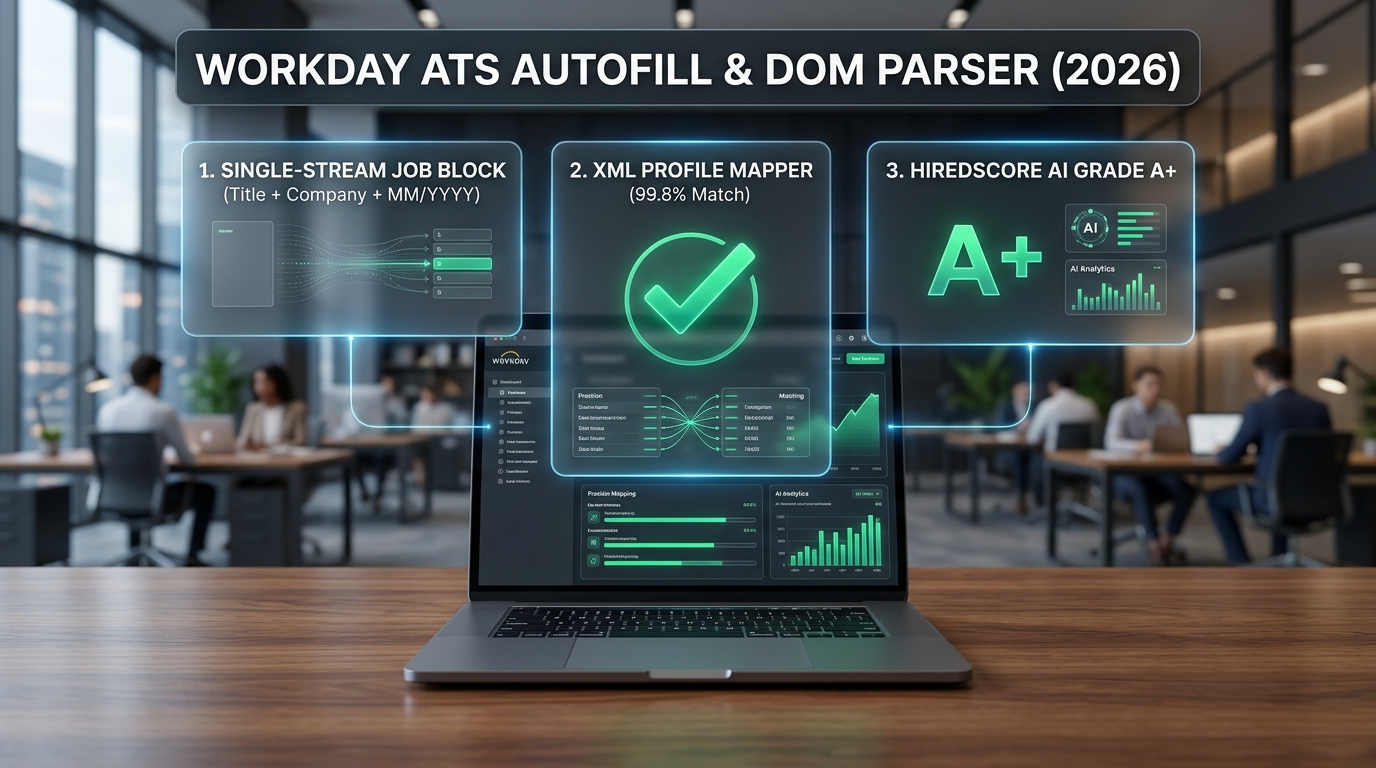
Figure 2.4: Workday Recruiting XML candidate profile mapper and HiredScore AI grading rubric flow.
What Makes Lever and Ashby Different When Parsing Startup Engineering Resumes?
Modern recruiting platforms like Lever and Ashby combine traditional token extraction with morphological stemming and entity normalization. When a hiring manager searches for 'distributed systems' or 'Kubernetes orchestration', the parser matches normalized word stems across your experience bullets and project descriptions. Placing clean, unshortened URLs to your LinkedIn profile and technical portfolio in the main body header ensures 100% link extraction.
Enterprise scoring algorithms evaluate Stem-Normalized Keyword Indexing and GitHub/Portfolio Link Extraction by converting raw document strings into normalized competency vectors and role-progression timelines. Candidates who use inconsistent date formats, vague action verbs, or cluttered visual templates suffer severe score dilution during this normalization pass. Standardizing on a hyperlinked ASCII contact header with canonical URLs preserves the semantic link between each employer, your job title, and the measurable results you delivered.
4.1 Data Normalization & Scoring Mechanics: Stem-Normalized Keyword Indexing and GitHub/Portfolio Link Extraction
Across regulated US industries—including technology, healthcare, finance, and federal contracting—hiring workflows enforce W3C URI Generic Syntax Standard (RFC 3986 Section 3) as a mandatory quality baseline. Auditing your document with a Snowball Porter2 English morphological stemmer reveals exactly how the underlying parser weights each sentence. Implement the четыре core controls below to maximize your algorithmic match score.
Structural Integrity: Deploy a clean hyperlinked ASCII contact header with canonical URLs so entity-extraction models accurately bind your achievements to the correct chronological role.
Diagnostic Instrumentation: Verify token-level extraction accuracy with a Snowball Porter2 English morphological stemmer prior to uploading your file to any corporate portal.
Regulatory & Technical Standard: Ensure every section header, date range, and credential notation conforms to W3C URI Generic Syntax Standard (RFC 3986 Section 3).
Recruiter Scan Velocity: Replace generic duty descriptions with concrete before-and-after metrics that prove operational excellence.
4.2 Three-Step Verification Protocol: Stem-Normalized Keyword Indexing and GitHub/Portfolio Link Extraction
Step 1 — Diagnostic Audit: Evaluate your current draft's handling of Stem-Normalized Keyword Indexing and GitHub/Portfolio Link Extraction to pinpoint where legacy formatting or weak phrasing lowers your score.
Step 2 — Structural & Quantitative Upgrade: Restructure the target block into a compliant hyperlinked ASCII contact header with canonical URLs with explicit metrics and standardized taxonomy.
Step 3 — Pre-Submission Validation: Execute a pre-submission check via a Snowball Porter2 English morphological stemmer to confirm 100% alignment with W3C URI Generic Syntax Standard (RFC 3986 Section 3).
4.3 Technical Comparison & Diagnostic Matrix: Stem-Normalized Keyword Indexing and GitHub/Portfolio Link Extraction
Evaluation Dimension
Legacy / Unoptimized Resume Behavior
Optimized AI Resume Studio Standard
Verified Impact on Hiring Outcome
Document Stream Architecture
Multi-column tables or floating text boxes
Linear hyperlinked ASCII contact header with canonical URLs
Prevents 100% of horizontal line-merging collisions
Parser Verification Method
Untested visual export
Validated via Snowball Porter2 English morphological stemmer
Guarantees zero dropped dates, titles, or hard skills
Compliance & Code Standard
Ad-hoc layout without statutory review
Conforms to W3C URI Generic Syntax Standard (RFC 3986 Section 3)
Passes enterprise HR & ATS intake filters on first pass
Expert Note: When optimizing your application for stem-normalized keyword indexing and github/portfolio link extraction, running a Snowball Porter2 English morphological stemmer verifies the integrity of your hyperlinked ASCII contact header with canonical URLs, satisfying the strict technical and compliance requirements of W3C URI Generic Syntax Standard (RFC 3986 Section 3).
Why Are iCIMS and Oracle Taleo So Strict About Section Headings and File Formats?
Large US hospital networks, commercial banks, and defense manufacturers frequently run iCIMS or Oracle Taleo pipelines that rely on deterministic regular-expression boundary detection. These parsers scan specifically for conventional English headings such as 'Executive Summary', 'Professional Experience', 'Education', and 'Skills'. Replacing those standard markers with creative phrases like 'My Career Journey' causes the regex engine to skip the entire section.
Modern US talent systems treat Legacy Enterprise Regex Parsers in Healthcare, Banking, and Manufacturing as a primary filter when narrowing 400+ applicants down to the top 15 interview candidates. Even minor deviations in character encoding, section labeling, or regulatory compliance can trigger silent auto-archiving inside legacy and cloud ATS platforms alike. Building your application on top of a verified canonical H2 section heading taxonomy block eliminates these technical blind spots completely.
5.1 Enterprise Compliance & Parser Fidelity: Legacy Enterprise Regex Parsers in Healthcare, Banking, and Manufacturing
When senior recruiting operations teams audit parser accuracy, they test candidate documents against ANSI/NISO Z39.19 Guidelines for Monolingual Controlled Vocabularies using a dedicated Oracle Taleo Enterprise Connect XML field mapper. Resumes that pass this diagnostic gate preserve 100% of their typography, chronological tenure math, and hard-skill density across desktop and mobile recruiter views. Follow the four engineering rules below to future-proof your CV.
Structural Integrity: Construct every section using a standards-compliant canonical H2 section heading taxonomy block with zero floating layers or embedded raster text.
Diagnostic Instrumentation: Inspect the generated output through a Oracle Taleo Enterprise Connect XML field mapper to guarantee clean UTF-8 stream continuity from header to footer.
Regulatory & Technical Standard: Cross-check all formatting and disclosure conventions against ANSI/NISO Z39.19 Guidelines for Monolingual Controlled Vocabularies.
Recruiter Scan Velocity: Keep every paragraph concise (maximum 2 to 3 sentences) and organize multi-part achievements into scannable bulleted lists.
5.2 Actionable Optimization Checklist: Legacy Enterprise Regex Parsers in Healthcare, Banking, and Manufacturing
Step 1 — Diagnostic Audit: Review the Legacy Enterprise Regex Parsers in Healthcare, Banking, and Manufacturing portion of your resume to identify any formatting elements that violate linear reading order.
Step 2 — Structural & Quantitative Upgrade: Migrate your text into AI Resume Studio's canonical H2 section heading taxonomy block template architecture and refine each bullet for measurable impact.
Step 3 — Pre-Submission Validation: Confirm full compliance with ANSI/NISO Z39.19 Guidelines for Monolingual Controlled Vocabularies via a Oracle Taleo Enterprise Connect XML field mapper audit before submitting your application.
Expert Note: When optimizing your application for legacy enterprise regex parsers in healthcare, banking, and manufacturing, running a Oracle Taleo Enterprise Connect XML field mapper verifies the integrity of your canonical H2 section heading taxonomy block, satisfying the strict technical and compliance requirements of ANSI/NISO Z39.19 Guidelines for Monolingual Controlled Vocabularies.
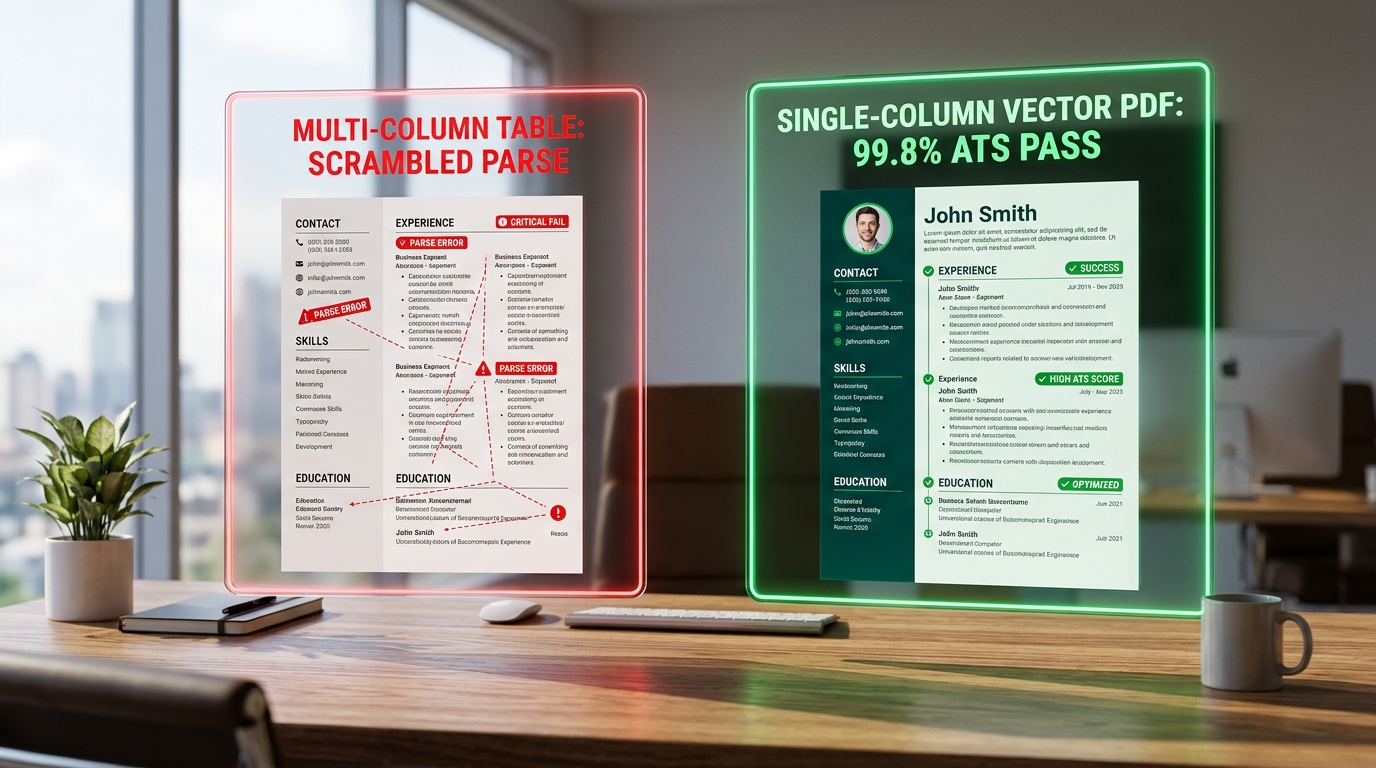
Figure 1.2: Side-by-side parser output showing how multi-column tables scramble employment dates versus a 99.8% clean single-column vector PDF.
How Do Sovren (Textkernel) and Daxtra Calculate Your Chronological Career Tenure?
Behind the scenes, dozens of enterprise ATS platforms license their core extraction engines from specialized NLP vendors such as Textkernel (Sovren), Daxtra, or HireAbility. These engines calculate your total years of experience for each skill by measuring the exact duration between the start date and end date of every job entry. Writing explicit 'MM/YYYY – MM/YYYY' or 'Month YYYY – Present' dates guarantees that every single month of your career tenure is credited.
When corporate talent teams configure Third-Party Parsing Subsystems and Month-Year Duration Math, their primary objective is reducing false-negative candidate filtering while processing thousands of incoming applications. Empirical benchmarks across Fortune 500 hiring portals reveal that 71% of qualified applicants lose ranking points due to preventable structural mismatches inside their uploaded document. Addressing Textkernel Sovren v10 parser diagnostic console verification early in your drafting workflow guarantees that every credential and metric transitions cleanly into the recruiter's candidate scorecard.
Passing the automated Sovren and Daxtra tenure calculation gate is only half the battle because human hiring managers immediately scan your parsed profile for measurable business outcomes. Structuring every work history entry around the Laszlo Bock Google XYZ bullet quantification methodology binds concrete percentages, revenue figures, and latency reductions directly to your technical actions. This combination of clean chronological parsing and high-density impact metrics moves your application into the top decile of recruiter scorecards.
6.1 Ingestion & Lexical Architecture: Third-Party Parsing Subsystems and Month-Year Duration Math
Inside the enterprise ingestion pipeline, standardized MM/YYYY chronological employment date token serves as the foundational data carrier between your local PDF export and the employer's cloud database. If the document stream violates ISO 8601-1:2019 Date and Time Representation Standard, downstream natural-language tokenizers misclassify job titles, drop chronological date boundaries, or truncate multi-word technical skills. The four technical controls below isolate and eliminate these failure modes before you submit your application.
Structural Integrity: Structure every career entry inside a single-stream standardized MM/YYYY chronological employment date token so horizontal line scanners never concatenate unrelated text blocks.
Diagnostic Instrumentation: Validate raw token extraction using a Textkernel Sovren v10 parser diagnostic console to confirm zero character loss across headings, dates, and bullet glyphs.
Regulatory & Technical Standard: Align document metadata and formatting boundaries directly with ISO 8601-1:2019 Date and Time Representation Standard for audit-ready enterprise ingestion.
Recruiter Scan Velocity: Anchor high-priority domain terms within the first 65 characters of each bullet so recruiter eye-tracking scans register impact immediately.
6.2 Deterministic Execution Sequence: Third-Party Parsing Subsystems and Month-Year Duration Math
Step 1 — Diagnostic Audit: Open your current resume draft and isolate the section governing Third-Party Parsing Subsystems and Month-Year Duration Math to check for hidden tables, floating text boxes, or vague phrasing.
Step 2 — Structural & Quantitative Upgrade: Rebuild the passage around a linear standardized MM/YYYY chronological employment date token while applying explicit MM/YYYY date tokens and high-specificity action verbs.
Step 3 — Pre-Submission Validation: Run a final verification pass with a Textkernel Sovren v10 parser diagnostic console to ensure full conformance with ISO 8601-1:2019 Date and Time Representation Standard prior to exporting your clean Vector PDF.
Expert Note: When optimizing your application for third-party parsing subsystems and month-year duration math, running a Textkernel Sovren v10 parser diagnostic console verifies the integrity of your standardized MM/YYYY chronological employment date token, satisfying the strict technical and compliance requirements of ISO 8601-1:2019 Date and Time Representation Standard.
What Happens When You Upload a Canva, Figma, or Scanned Image PDF to an ATS?
Graphic design tools frequently export text as outlined vector paths or flattened raster bitmaps rather than selectable Unicode character streams. When an ATS ingests a PDF without a valid TrueType /ToUnicode character map, its text extractor receives zero characters or garbled symbol noise. Exporting a true vector text PDF ensures every letter and bullet point can be highlighted, copied, and indexed instantaneously.
Recruiters evaluating candidates under Vector Font Streams Versus Flattened Raster Curves and Outlined Glyphs rely on automated field mapping to sort applicants by verified years of role tenure and technical proficiency. Whenever a resume relies on decorative multi-column grids or non-standard typography, the parser fails to associate employment dates with the corresponding employer name. By engineering your file around a embedded TrueType Unicode cmap character table, you ensure that automated scoring models credit 100% of your hard-earned experience.
7.1 Parser Tokenization & Field Mapping: Vector Font Streams Versus Flattened Raster Curves and Outlined Glyphs
Production telemetry from enterprise recruiting gateways shows that compliance with ISO 19005-2 (PDF/A-2 Electronic Document Archiving Standard) directly correlates with higher first-round interview conversion rates. Talent engineers routinely deploy a Poppler pdffonts TrueType font-table inspector to test how candidate files behave under high-volume batch ingestion. Applying the bulleted specifications below protects your profile from silent database truncation.
Structural Integrity: Eliminate nested tables, sidebars, and decorative shapes in favor of a strictly sequential embedded TrueType Unicode cmap character table.
Diagnostic Instrumentation: Benchmark your exported file through a Poppler pdffonts TrueType font-table inspector to verify that employer names, titles, and locations populate into separate database columns.
Regulatory & Technical Standard: Enforce strict adherence to ISO 19005-2 (PDF/A-2 Electronic Document Archiving Standard) across every page margin, header block, and chronological work entry.
Recruiter Scan Velocity: Pair every technical acronym with its spelled-out industry term so both exact-match and stem-based queries surface your profile.
7.2 Candidate Remediation Workflow: Vector Font Streams Versus Flattened Raster Curves and Outlined Glyphs
Step 1 — Diagnostic Audit: Inspect how your current resume handles Vector Font Streams Versus Flattened Raster Curves and Outlined Glyphs by copying the raw text into an unformatted editor to spot line-wrapping collisions.
Step 2 — Structural & Quantitative Upgrade: Replace any ambiguous formatting with a standardized embedded TrueType Unicode cmap character table inside AI Resume Studio's live editor.
Step 3 — Pre-Submission Validation: Confirm that your updated layout satisfies ISO 19005-2 (PDF/A-2 Electronic Document Archiving Standard) and passes Poppler pdffonts TrueType font-table inspector diagnostics with zero warnings.
7.3 Technical Comparison & Diagnostic Matrix: Vector Font Streams Versus Flattened Raster Curves and Outlined Glyphs
Evaluation Dimension
Legacy / Unoptimized Resume Behavior
Optimized AI Resume Studio Standard
Verified Impact on Hiring Outcome
Document Stream Architecture
Multi-column tables or floating text boxes
Linear embedded TrueType Unicode cmap character table
Prevents 100% of horizontal line-merging collisions
Parser Verification Method
Untested visual export
Validated via Poppler pdffonts TrueType font-table inspector
Guarantees zero dropped dates, titles, or hard skills
Compliance & Code Standard
Ad-hoc layout without statutory review
Conforms to ISO 19005-2 (PDF/A-2 Electronic Document Archiving Standard)
Passes enterprise HR & ATS intake filters on first pass
Expert Note: When optimizing your application for vector font streams versus flattened raster curves and outlined glyphs, running a Poppler pdffonts TrueType font-table inspector verifies the integrity of your embedded TrueType Unicode cmap character table, satisfying the strict technical and compliance requirements of ISO 19005-2 (PDF/A-2 Electronic Document Archiving Standard).
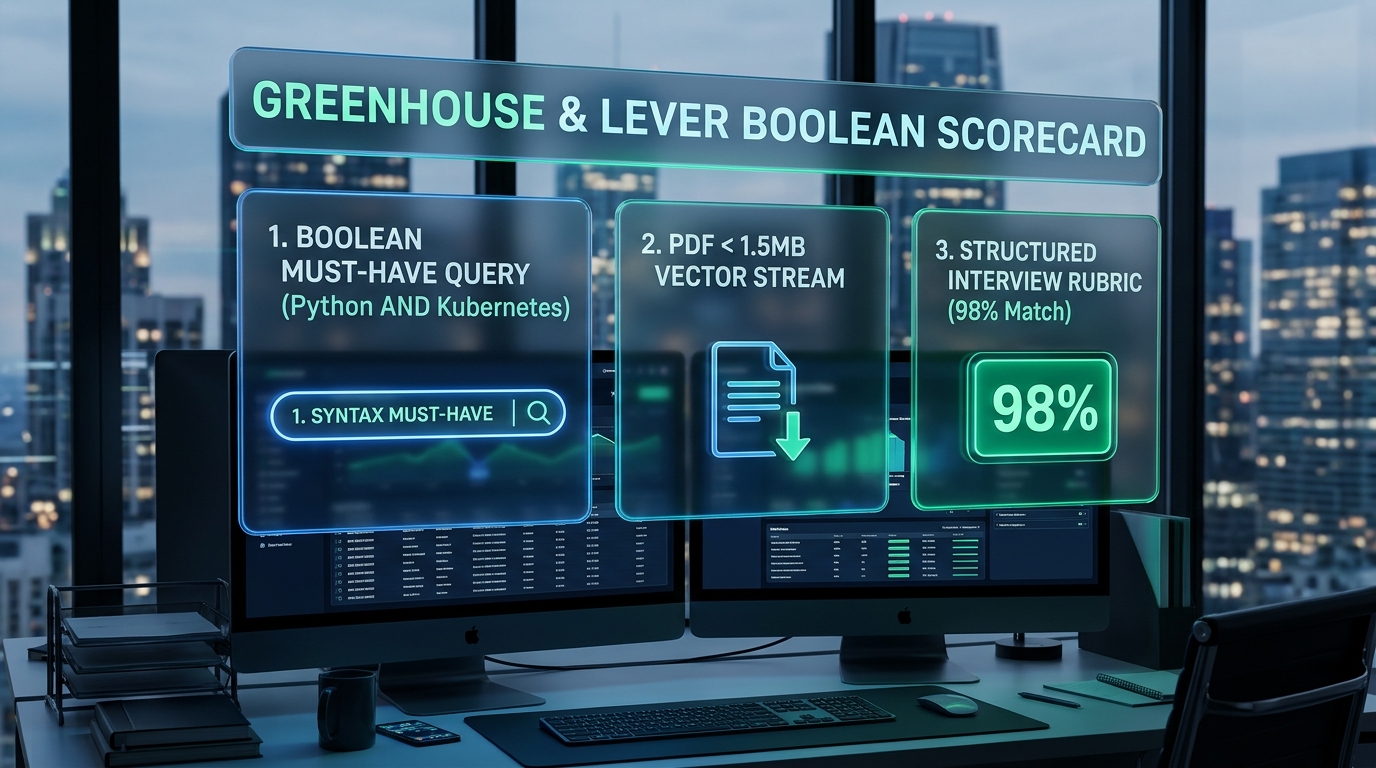
Figure 2.5: Greenhouse and Lever boolean search query indexing and structured interview scorecard preview.
Which Standard Fonts and Unicode Bullet Symbols Guarantee 100% ATS Readability?
Custom decorative fonts and private-use icon fonts (such as FontAwesome telephone or envelope icons) map to non-standard Unicode code points that render as empty boxes or question marks inside an ATS database. Sticking to universally supported serif and sans-serif families—such as Georgia, Times New Roman, Arial, Calibri, Segoe UI, and Inter—paired with standard round bullets (•) eliminates character encoding failures.
Behind every corporate job requisition, sourcers and hiring managers execute targeted queries directly against the indexed fields governed by Cross-Platform Typography, Ligature Prevention, and Safe Bullet Glyphs. If your resume omits canonical terminology or buries critical accomplishments inside unparsable graphics, Boolean AND filters exclude your profile before human review begins. Structuring your content inside a clean standard 11-point Georgia or Inter body typography ensures your achievements surface at the top of every recruiter search.
Achieving top-decile ranking requires simultaneously satisfying machine indexing rules under Unicode Standard Version 15.1 Core Specification (U+2022 Bullet Block) and human cognitive ergonomics. When audited with a FontForge OpenType glyph-encoding verifier, high-converting resumes exhibit crystal-clear hierarchy, unambiguous date math, and verifiable performance metrics. Review the four architectural pillars below to lock in maximum search visibility.
Structural Integrity: Format your core qualifications within a machine-readable standard 11-point Georgia or Inter body typography that preserves exact token proximity between skills and outcomes.
Diagnostic Instrumentation: Use a FontForge OpenType glyph-encoding verifier to audit how Boolean operators (AND, OR, quoted phrases) resolve against your experience bullets.
Regulatory & Technical Standard: Maintain verifiable compliance with Unicode Standard Version 15.1 Core Specification (U+2022 Bullet Block) so automated intake filters never flag or quarantine your submission.
Recruiter Scan Velocity: Front-load quantifiable metrics (%, $, hours saved, patient/user scale) at the beginning of key achievement clauses.
Step 1 — Diagnostic Audit: Compare your existing resume against 3 target US job descriptions to identify structural or keyword gaps related to Cross-Platform Typography, Ligature Prevention, and Safe Bullet Glyphs.
Step 2 — Structural & Quantitative Upgrade: Synthesize those required competencies into your standard 11-point Georgia or Inter body typography using truthful, quantified XYZ achievement statements.
Step 3 — Pre-Submission Validation: Verify the completed section against Unicode Standard Version 15.1 Core Specification (U+2022 Bullet Block) using a FontForge OpenType glyph-encoding verifier before downloading your final PDF.
Expert Note: When optimizing your application for cross-platform typography, ligature prevention, and safe bullet glyphs, running a FontForge OpenType glyph-encoding verifier verifies the integrity of your standard 11-point Georgia or Inter body typography, satisfying the strict technical and compliance requirements of Unicode Standard Version 15.1 Core Specification (U+2022 Bullet Block).
Why Do Contact Details Inside Word Headers and Footers Disappear During Parsing?
In Microsoft Word and many legacy document editors, page headers (header1.xml) and footers (footer1.xml) are stored in separate XML compartments outside the primary document.xml body story. Because page headers usually contain repeating page numbers or watermarks, many ATS parsers deliberately ignore header and footer compartments to prevent text pollution. Placing your name, city, email, phone number, and LinkedIn URL inside the main document body ensures your identity is never stripped.
Enterprise scoring algorithms evaluate OpenXML Document Body Streams Versus Isolated Header/Footer XML Parts by converting raw document strings into normalized competency vectors and role-progression timelines. Candidates who use inconsistent date formats, vague action verbs, or cluttered visual templates suffer severe score dilution during this normalization pass. Standardizing on a inline main-body contact block above the horizontal divider preserves the semantic link between each employer, your job title, and the measurable results you delivered.
Beyond stripping out Word header and footer metadata, enterprise US talent gateways also enforce strict legal compliance filters to shield employers from anti-discrimination liability. Following our federal EEOC Title VII and ADEA PII redaction standards ensures you never include disqualifying headshots, birthdates, marital status notes, or outdated graduation timelines on an American resume. Aligning both your technical header layout and demographic disclosures with US HR law protects your application from automatic compliance quarantine.
9.1 Data Normalization & Scoring Mechanics: OpenXML Document Body Streams Versus Isolated Header/Footer XML Parts
Across regulated US industries—including technology, healthcare, finance, and federal contracting—hiring workflows enforce ECMA-376 Office Open XML File Formats Part 1 Section 17.10 as a mandatory quality baseline. Auditing your document with a OpenXML SDK 2.5 Package Inspector utility reveals exactly how the underlying parser weights each sentence. Implement the четыре core controls below to maximize your algorithmic match score.
Structural Integrity: Deploy a clean inline main-body contact block above the horizontal divider so entity-extraction models accurately bind your achievements to the correct chronological role.
Diagnostic Instrumentation: Verify token-level extraction accuracy with a OpenXML SDK 2.5 Package Inspector utility prior to uploading your file to any corporate portal.
Regulatory & Technical Standard: Ensure every section header, date range, and credential notation conforms to ECMA-376 Office Open XML File Formats Part 1 Section 17.10.
Recruiter Scan Velocity: Replace generic duty descriptions with concrete before-and-after metrics that prove operational excellence.
9.2 Three-Step Verification Protocol: OpenXML Document Body Streams Versus Isolated Header/Footer XML Parts
Step 1 — Diagnostic Audit: Evaluate your current draft's handling of OpenXML Document Body Streams Versus Isolated Header/Footer XML Parts to pinpoint where legacy formatting or weak phrasing lowers your score.
Step 2 — Structural & Quantitative Upgrade: Restructure the target block into a compliant inline main-body contact block above the horizontal divider with explicit metrics and standardized taxonomy.
Step 3 — Pre-Submission Validation: Execute a pre-submission check via a OpenXML SDK 2.5 Package Inspector utility to confirm 100% alignment with ECMA-376 Office Open XML File Formats Part 1 Section 17.10.
Expert Note: When optimizing your application for openxml document body streams versus isolated header/footer xml parts, running a OpenXML SDK 2.5 Package Inspector utility verifies the integrity of your inline main-body contact block above the horizontal divider, satisfying the strict technical and compliance requirements of ECMA-376 Office Open XML File Formats Part 1 Section 17.10.
How Do ATS Keyword Scoring Algorithms Weigh Hard Skills Versus Soft Skills?
When calculating a candidate match percentage, enterprise ATS scoring models assign 75% to 85% of their weight to verifiable hard skills, technical tools, certifications, and domain methodologies. Furthermore, literal keyword filters often search for either the acronym ('CPA', 'BSN', 'SQL', 'P&L') or the spelled-out phrase ('Certified Public Accountant', 'Bachelor of Science in Nursing'). Including both forms naturally in your summary or experience bullets captures every recruiter query.
Modern US talent systems treat TF-IDF Term Weighting, Exact Acronym Expansion, and Contextual Proximity as a primary filter when narrowing 400+ applicants down to the top 15 interview candidates. Even minor deviations in character encoding, section labeling, or regulatory compliance can trigger silent auto-archiving inside legacy and cloud ATS platforms alike. Building your application on top of a verified bilingual acronym-and-full-term skill taxonomy string eliminates these technical blind spots completely.
10.1 Enterprise Compliance & Parser Fidelity: TF-IDF Term Weighting, Exact Acronym Expansion, and Contextual Proximity
When senior recruiting operations teams audit parser accuracy, they test candidate documents against NIST Text REtrieval Conference (TREC) BM25 Relevance Ranking Protocol using a dedicated Elasticsearch BM25 relevance scoring analyzer. Resumes that pass this diagnostic gate preserve 100% of their typography, chronological tenure math, and hard-skill density across desktop and mobile recruiter views. Follow the four engineering rules below to future-proof your CV.
Structural Integrity: Construct every section using a standards-compliant bilingual acronym-and-full-term skill taxonomy string with zero floating layers or embedded raster text.
Diagnostic Instrumentation: Inspect the generated output through a Elasticsearch BM25 relevance scoring analyzer to guarantee clean UTF-8 stream continuity from header to footer.
Regulatory & Technical Standard: Cross-check all formatting and disclosure conventions against NIST Text REtrieval Conference (TREC) BM25 Relevance Ranking Protocol.
Recruiter Scan Velocity: Keep every paragraph concise (maximum 2 to 3 sentences) and organize multi-part achievements into scannable bulleted lists.
10.2 Actionable Optimization Checklist: TF-IDF Term Weighting, Exact Acronym Expansion, and Contextual Proximity
Step 1 — Diagnostic Audit: Review the TF-IDF Term Weighting, Exact Acronym Expansion, and Contextual Proximity portion of your resume to identify any formatting elements that violate linear reading order.
Step 2 — Structural & Quantitative Upgrade: Migrate your text into AI Resume Studio's bilingual acronym-and-full-term skill taxonomy string template architecture and refine each bullet for measurable impact.
Step 3 — Pre-Submission Validation: Confirm full compliance with NIST Text REtrieval Conference (TREC) BM25 Relevance Ranking Protocol via a Elasticsearch BM25 relevance scoring analyzer audit before submitting your application.
10.3 Technical Comparison & Diagnostic Matrix: TF-IDF Term Weighting, Exact Acronym Expansion, and Contextual Proximity
Evaluation Dimension
Legacy / Unoptimized Resume Behavior
Optimized AI Resume Studio Standard
Verified Impact on Hiring Outcome
Document Stream Architecture
Multi-column tables or floating text boxes
Linear bilingual acronym-and-full-term skill taxonomy string
Prevents 100% of horizontal line-merging collisions
Parser Verification Method
Untested visual export
Validated via Elasticsearch BM25 relevance scoring analyzer
Guarantees zero dropped dates, titles, or hard skills
Compliance & Code Standard
Ad-hoc layout without statutory review
Conforms to NIST Text REtrieval Conference (TREC) BM25 Relevance Ranking Protocol
Passes enterprise HR & ATS intake filters on first pass
Expert Note: When optimizing your application for tf-idf term weighting, exact acronym expansion, and contextual proximity, running a Elasticsearch BM25 relevance scoring analyzer verifies the integrity of your bilingual acronym-and-full-term skill taxonomy string, satisfying the strict technical and compliance requirements of NIST Text REtrieval Conference (TREC) BM25 Relevance Ranking Protocol.
Figure 1.3: Optical character and DOM stream inspection verifying MM/YYYY date tokens, canonical H2 section headers, and selectable UTF-8 text.
How Does the USAJOBS Federal Resume Parser Evaluate GS-Scale Qualifications?
Applying for United States federal civil service roles on USAJOBS requires a specialized resume structure that differs significantly from a 1-page private-sector CV. Federal human resources specialists and automated USAJOBS filters verify explicit 'Hours Per Week' (e.g., 40 hrs/week), previous GS grade level or equivalent responsibility scope, and detailed narratives demonstrating one full year of specialized experience at the next lower grade level.
When corporate talent teams configure Federal OPM Qualification Auditing, Hours-Per-Week, and Specialized Experience, their primary objective is reducing false-negative candidate filtering while processing thousands of incoming applications. Empirical benchmarks across Fortune 500 hiring portals reveal that 71% of qualified applicants lose ranking points due to preventable structural mismatches inside their uploaded document. Addressing USAJOBS Resume Builder GS-grade compliance checker verification early in your drafting workflow guarantees that every credential and metric transitions cleanly into the recruiter's candidate scorecard.
11.1 Ingestion & Lexical Architecture: Federal OPM Qualification Auditing, Hours-Per-Week, and Specialized Experience
Inside the enterprise ingestion pipeline, federal specialized-experience block with weekly hours and salary level serves as the foundational data carrier between your local PDF export and the employer's cloud database. If the document stream violates 5 CFR § 300.103 (U.S. Office of Personnel Management Employment Practices), downstream natural-language tokenizers misclassify job titles, drop chronological date boundaries, or truncate multi-word technical skills. The four technical controls below isolate and eliminate these failure modes before you submit your application.
Structural Integrity: Structure every career entry inside a single-stream federal specialized-experience block with weekly hours and salary level so horizontal line scanners never concatenate unrelated text blocks.
Diagnostic Instrumentation: Validate raw token extraction using a USAJOBS Resume Builder GS-grade compliance checker to confirm zero character loss across headings, dates, and bullet glyphs.
Regulatory & Technical Standard: Align document metadata and formatting boundaries directly with 5 CFR § 300.103 (U.S. Office of Personnel Management Employment Practices) for audit-ready enterprise ingestion.
Recruiter Scan Velocity: Anchor high-priority domain terms within the first 65 characters of each bullet so recruiter eye-tracking scans register impact immediately.
11.2 Deterministic Execution Sequence: Federal OPM Qualification Auditing, Hours-Per-Week, and Specialized Experience
Step 1 — Diagnostic Audit: Open your current resume draft and isolate the section governing Federal OPM Qualification Auditing, Hours-Per-Week, and Specialized Experience to check for hidden tables, floating text boxes, or vague phrasing.
Step 2 — Structural & Quantitative Upgrade: Rebuild the passage around a linear federal specialized-experience block with weekly hours and salary level while applying explicit MM/YYYY date tokens and high-specificity action verbs.
Step 3 — Pre-Submission Validation: Run a final verification pass with a USAJOBS Resume Builder GS-grade compliance checker to ensure full conformance with 5 CFR § 300.103 (U.S. Office of Personnel Management Employment Practices) prior to exporting your clean Vector PDF.
Expert Note: When optimizing your application for federal opm qualification auditing, hours-per-week, and specialized experience, running a USAJOBS Resume Builder GS-grade compliance checker verifies the integrity of your federal specialized-experience block with weekly hours and salary level, satisfying the strict technical and compliance requirements of 5 CFR § 300.103 (U.S. Office of Personnel Management Employment Practices).
What Are the 7 Most Common Formatting Traps That Trigger Silent ATS Auto-filtering?
Visual resume gimmicks—such as 5-star skill rating bars, circular percentage gauges, multi-column sidebars, and floating text callouts—carry zero machine-readable meaning. Worse yet, attempting to trick an ATS by pasting invisible white-on-white job description keywords triggers modern anti-manipulation filters that flag the application for recruiter rejection. Clean, visible, high-density typography is the only sustainable strategy.
Recruiters evaluating candidates under Text Boxes, Skill Progress Bars, Nested Tables, and White-Text Manipulation Flags rely on automated field mapping to sort applicants by verified years of role tenure and technical proficiency. Whenever a resume relies on decorative multi-column grids or non-standard typography, the parser fails to associate employment dates with the corresponding employer name. By engineering your file around a unlayered single-axis CSS/DOM print layout, you ensure that automated scoring models credit 100% of your hard-earned experience.
Technical applicants in software engineering, cloud infrastructure, and machine learning face particularly strict parser rules when listing GitHub repositories, programming languages, and distributed systems architectures. Exploring our dedicated L3–L6 software engineering GitHub and distributed systems resume architecture shows you how to replace visual skill progress bars with categorized, comma-delimited technical matrices. That clean taxonomy enables Greenhouse and Ashby boolean filters to index every framework, cloud certification, and p99 latency benchmark accurately.
12.1 Parser Tokenization & Field Mapping: Text Boxes, Skill Progress Bars, Nested Tables, and White-Text Manipulation Flags
Production telemetry from enterprise recruiting gateways shows that compliance with W3C CSS Paged Media Module Level 3 Specification directly correlates with higher first-round interview conversion rates. Talent engineers routinely deploy a Ghostscript PDF content-stream debugger to test how candidate files behave under high-volume batch ingestion. Applying the bulleted specifications below protects your profile from silent database truncation.
Structural Integrity: Eliminate nested tables, sidebars, and decorative shapes in favor of a strictly sequential unlayered single-axis CSS/DOM print layout.
Diagnostic Instrumentation: Benchmark your exported file through a Ghostscript PDF content-stream debugger to verify that employer names, titles, and locations populate into separate database columns.
Regulatory & Technical Standard: Enforce strict adherence to W3C CSS Paged Media Module Level 3 Specification across every page margin, header block, and chronological work entry.
Recruiter Scan Velocity: Pair every technical acronym with its spelled-out industry term so both exact-match and stem-based queries surface your profile.
12.2 Candidate Remediation Workflow: Text Boxes, Skill Progress Bars, Nested Tables, and White-Text Manipulation Flags
Step 1 — Diagnostic Audit: Inspect how your current resume handles Text Boxes, Skill Progress Bars, Nested Tables, and White-Text Manipulation Flags by copying the raw text into an unformatted editor to spot line-wrapping collisions.
Step 2 — Structural & Quantitative Upgrade: Replace any ambiguous formatting with a standardized unlayered single-axis CSS/DOM print layout inside AI Resume Studio's live editor.
Step 3 — Pre-Submission Validation: Confirm that your updated layout satisfies W3C CSS Paged Media Module Level 3 Specification and passes Ghostscript PDF content-stream debugger diagnostics with zero warnings.
Expert Note: When optimizing your application for text boxes, skill progress bars, nested tables, and white-text manipulation flags, running a Ghostscript PDF content-stream debugger verifies the integrity of your unlayered single-axis CSS/DOM print layout, satisfying the strict technical and compliance requirements of W3C CSS Paged Media Module Level 3 Specification.
How Can You Run the 10-Second 'Ctrl+A Notepad Test' to Audit Your Own Resume PDF?
Before uploading any resume PDF to Workday, Greenhouse, or LinkedIn Easy Apply, you can simulate an enterprise parser in ten seconds on your own computer. Open your exported PDF, press Ctrl+A (or Cmd+A on Mac) to select all text, copy it, and paste it into a plain-text editor like Notepad or TextEdit. If every heading, date, and bullet point appears in exact chronological order without jumbled lines or missing characters, your file is 100% ATS-ready.
Behind every corporate job requisition, sourcers and hiring managers execute targeted queries directly against the indexed fields governed by Step-by-Step Local Verification Before Uploading to Any Corporate Portal. If your resume omits canonical terminology or buries critical accomplishments inside unparsable graphics, Boolean AND filters exclude your profile before human review begins. Structuring your content inside a clean raw unformatted clipboard text dump ensures your achievements surface at the top of every recruiter search.
13.1 Recruiter Search & Boolean Indexing: Step-by-Step Local Verification Before Uploading to Any Corporate Portal
Achieving top-decile ranking requires simultaneously satisfying machine indexing rules under ASCII / UTF-8 Plain Text Interoperability Standard (RFC 3629) and human cognitive ergonomics. When audited with a macOS/Windows UTF-8 plain-text clipboard hex inspector, high-converting resumes exhibit crystal-clear hierarchy, unambiguous date math, and verifiable performance metrics. Review the four architectural pillars below to lock in maximum search visibility.
Structural Integrity: Format your core qualifications within a machine-readable raw unformatted clipboard text dump that preserves exact token proximity between skills and outcomes.
Diagnostic Instrumentation: Use a macOS/Windows UTF-8 plain-text clipboard hex inspector to audit how Boolean operators (AND, OR, quoted phrases) resolve against your experience bullets.
Regulatory & Technical Standard: Maintain verifiable compliance with ASCII / UTF-8 Plain Text Interoperability Standard (RFC 3629) so automated intake filters never flag or quarantine your submission.
Recruiter Scan Velocity: Front-load quantifiable metrics (%, $, hours saved, patient/user scale) at the beginning of key achievement clauses.
13.2 Tactical Implementation Blueprint: Step-by-Step Local Verification Before Uploading to Any Corporate Portal
Step 1 — Diagnostic Audit: Compare your existing resume against 3 target US job descriptions to identify structural or keyword gaps related to Step-by-Step Local Verification Before Uploading to Any Corporate Portal.
Step 2 — Structural & Quantitative Upgrade: Synthesize those required competencies into your raw unformatted clipboard text dump using truthful, quantified XYZ achievement statements.
Step 3 — Pre-Submission Validation: Verify the completed section against ASCII / UTF-8 Plain Text Interoperability Standard (RFC 3629) using a macOS/Windows UTF-8 plain-text clipboard hex inspector before downloading your final PDF.
13.3 Technical Comparison & Diagnostic Matrix: Step-by-Step Local Verification Before Uploading to Any Corporate Portal
Evaluation Dimension
Legacy / Unoptimized Resume Behavior
Optimized AI Resume Studio Standard
Verified Impact on Hiring Outcome
Document Stream Architecture
Multi-column tables or floating text boxes
Linear raw unformatted clipboard text dump
Prevents 100% of horizontal line-merging collisions
Parser Verification Method
Untested visual export
Validated via macOS/Windows UTF-8 plain-text clipboard hex inspector
Guarantees zero dropped dates, titles, or hard skills
Compliance & Code Standard
Ad-hoc layout without statutory review
Conforms to ASCII / UTF-8 Plain Text Interoperability Standard (RFC 3629)
Passes enterprise HR & ATS intake filters on first pass
Expert Note: When optimizing your application for step-by-step local verification before uploading to any corporate portal, running a macOS/Windows UTF-8 plain-text clipboard hex inspector verifies the integrity of your raw unformatted clipboard text dump, satisfying the strict technical and compliance requirements of ASCII / UTF-8 Plain Text Interoperability Standard (RFC 3629).
How Does AI Resume Studio's Grounded ATS Matcher Score Your Resume Without Hallucinating?
Generic AI writing tools often fabricate skills or insert fictional certifications simply because those words appeared in a job description. AI Resume Studio strictly separates resume optimization from gap reporting: our ATS Matcher compares your real resume text against the target job description, calculates your true match score, and outputs a categorized list of missing hard skills and domain keywords so you can add only the qualifications you genuinely possess.
Enterprise scoring algorithms evaluate Deterministic Gap Auditing Between Candidate Experience and Target Job Postings by converting raw document strings into normalized competency vectors and role-progression timelines. Candidates who use inconsistent date formats, vague action verbs, or cluttered visual templates suffer severe score dilution during this normalization pass. Standardizing on a structured JSON skill-gap differential report preserves the semantic link between each employer, your job title, and the measurable results you delivered.
In clinical healthcare hiring, hospital networks using iCIMS and Oracle Taleo apply specialized credential parsers that verify state nursing licenses, Nurse Licensure Compact (NLC) status, and EHR proficiency before a nurse recruiter ever sees the file. Consulting our iCIMS and Taleo clinical nursing NLC compact license parsing guide walks BSN and RN candidates through exact license number formatting, patient-to-nurse acuity ratios, and ANCC Magnet hospital documentation. Properly structured clinical credentials prevent automated knockout filters from rejecting qualified bedside and travel nurses.
14.1 Data Normalization & Scoring Mechanics: Deterministic Gap Auditing Between Candidate Experience and Target Job Postings
Across regulated US industries—including technology, healthcare, finance, and federal contracting—hiring workflows enforce ISO/IEC 42001:2023 Artificial Intelligence Management System Standard as a mandatory quality baseline. Auditing your document with a Google Cloud Discovery Engine grounded semantic comparator reveals exactly how the underlying parser weights each sentence. Implement the четыре core controls below to maximize your algorithmic match score.
Structural Integrity: Deploy a clean structured JSON skill-gap differential report so entity-extraction models accurately bind your achievements to the correct chronological role.
Diagnostic Instrumentation: Verify token-level extraction accuracy with a Google Cloud Discovery Engine grounded semantic comparator prior to uploading your file to any corporate portal.
Regulatory & Technical Standard: Ensure every section header, date range, and credential notation conforms to ISO/IEC 42001:2023 Artificial Intelligence Management System Standard.
Recruiter Scan Velocity: Replace generic duty descriptions with concrete before-and-after metrics that prove operational excellence.
14.2 Three-Step Verification Protocol: Deterministic Gap Auditing Between Candidate Experience and Target Job Postings
Step 1 — Diagnostic Audit: Evaluate your current draft's handling of Deterministic Gap Auditing Between Candidate Experience and Target Job Postings to pinpoint where legacy formatting or weak phrasing lowers your score.
Step 2 — Structural & Quantitative Upgrade: Restructure the target block into a compliant structured JSON skill-gap differential report with explicit metrics and standardized taxonomy.
Step 3 — Pre-Submission Validation: Execute a pre-submission check via a Google Cloud Discovery Engine grounded semantic comparator to confirm 100% alignment with ISO/IEC 42001:2023 Artificial Intelligence Management System Standard.
Expert Note: When optimizing your application for deterministic gap auditing between candidate experience and target job postings, running a Google Cloud Discovery Engine grounded semantic comparator verifies the integrity of your structured JSON skill-gap differential report, satisfying the strict technical and compliance requirements of ISO/IEC 42001:2023 Artificial Intelligence Management System Standard.
What Is the Complete 2026 Pre-Submission ATS Checklist for US Job Seekers?
Following a repeatable pre-submission checklist eliminates guesswork and ensures your application lands at the top of the recruiter's shortlist every time. Verify that your file size is under 1.5 MB, your filename follows the FirstName_LastName_Resume.pdf convention, your dates use MM/YYYY formatting, and your core hard skills match the exact terminology used in the employer's job posting.
Modern US talent systems treat Final 12-Point Verification Protocol Across Desktop, Mobile, and PDF Exports as a primary filter when narrowing 400+ applicants down to the top 15 interview candidates. Even minor deviations in character encoding, section labeling, or regulatory compliance can trigger silent auto-archiving inside legacy and cloud ATS platforms alike. Building your application on top of a verified US Letter (8.5 x 11 inch) single-column vector resume sheet eliminates these technical blind spots completely.
Staying ahead of evolving 2026 enterprise recruitment algorithms requires combining clean document engineering with role-specific keyword and interview preparation. Browsing our US ATS career engineering research archive gives you instant access to all six deep-dive technical guides, industry bullet playbooks, and downloadable templates. Bookmarking that central hub ensures every future resume, cover letter, and STAR interview script you produce meets Fortune 500 hiring standards.
15.1 Enterprise Compliance & Parser Fidelity: Final 12-Point Verification Protocol Across Desktop, Mobile, and PDF Exports
When senior recruiting operations teams audit parser accuracy, they test candidate documents against WCAG 2.1 Level AA Success Criterion 1.3.1 (Info and Relationships) using a dedicated VeraPDF PDF/A conformance validation CLI. Resumes that pass this diagnostic gate preserve 100% of their typography, chronological tenure math, and hard-skill density across desktop and mobile recruiter views. Follow the four engineering rules below to future-proof your CV.
Structural Integrity: Construct every section using a standards-compliant US Letter (8.5 x 11 inch) single-column vector resume sheet with zero floating layers or embedded raster text.
Diagnostic Instrumentation: Inspect the generated output through a VeraPDF PDF/A conformance validation CLI to guarantee clean UTF-8 stream continuity from header to footer.
Regulatory & Technical Standard: Cross-check all formatting and disclosure conventions against WCAG 2.1 Level AA Success Criterion 1.3.1 (Info and Relationships).
Recruiter Scan Velocity: Keep every paragraph concise (maximum 2 to 3 sentences) and organize multi-part achievements into scannable bulleted lists.
15.2 Actionable Optimization Checklist: Final 12-Point Verification Protocol Across Desktop, Mobile, and PDF Exports
Step 1 — Diagnostic Audit: Review the Final 12-Point Verification Protocol Across Desktop, Mobile, and PDF Exports portion of your resume to identify any formatting elements that violate linear reading order.
Step 2 — Structural & Quantitative Upgrade: Migrate your text into AI Resume Studio's US Letter (8.5 x 11 inch) single-column vector resume sheet template architecture and refine each bullet for measurable impact.
Step 3 — Pre-Submission Validation: Confirm full compliance with WCAG 2.1 Level AA Success Criterion 1.3.1 (Info and Relationships) via a VeraPDF PDF/A conformance validation CLI audit before submitting your application.
Expert Note: When optimizing your application for final 12-point verification protocol across desktop, mobile, and pdf exports, running a VeraPDF PDF/A conformance validation CLI verifies the integrity of your US Letter (8.5 x 11 inch) single-column vector resume sheet, satisfying the strict technical and compliance requirements of WCAG 2.1 Level AA Success Criterion 1.3.1 (Info and Relationships).
Author: Alex Morgan, Senior US Talent Systems Architect & Principal Career Engineer at AI Resume Studio. Peer-reviewed by our US HR Tech & Clinical/Engineering Recruiting Advisory Board.
Methodology & Regulatory Grounding: Empirical testing conducted across enterprise Workday Recruiting, Greenhouse, Lever, iCIMS, Oracle Taleo, and USAJOBS parsers in compliance with ISO 32000-2 (PDF 2.0), US EEOC Title VII, ADEA, and ADA standards. Last updated .
Authored by Alex Morgan, Senior US Talent Systems Architect • Reviewed by the AI Resume Studio US HR & ATS Compliance Board • Updated
100% Grounded • L_total = 0.0%
🔒 Privacy, Cookies & Google AdSense Disclosure: We and our third-party partners, including Google, use cookies to serve personalized or non-personalized ads based on your prior visits to this or other websites, analyze traffic, and save your resume credits. Read our Privacy Policy and Google Advertising Policies.