Sub-Pillar #4 • US Anti-Discrimination & HR Legal Standards • US Employment Law & HR Compliance
US EEOC Title VII, ADEA & ADA Resume Compliance Guide: What Never to Include on an American CV (2026)
✍️ By Alex Morgan, Senior US Talent Systems Architect📅 Published: ⏱️ 25 min read✅ Grounded US ATS & EEOC Verified
Mastering us eeoc resume compliance rules is the single highest-leverage advantage for American job seekers navigating automated corporate hiring pipelines in 2026.
Whether you are targeting a Fortune 500 executive role on Workday, a Silicon Valley engineering team on Greenhouse, or a clinical hospital network on iCIMS, small technical decisions determine whether your profile ranks #1 or disappears silently.
This comprehensive 2026 engineering post breaks down every rule, diagnostic benchmark, and real-world transformation you need to succeed.
Figure 3.1: How US EEOC Title VII and ADEA compliance rules govern pre-employment resume screening across American corporations.
⚡ Quick Answer • 2026 US ATS Engineering Benchmark
Direct Summary: Under US Equal Employment Opportunity Commission (EEOC) compliance standards—enforced via Title VII of the Civil Rights Act, the Age Discrimination in Employment Act (ADEA), and the Americans with Disabilities Act (ADA)—an American resume must never include candidate headshots/photos, date of birth, age, marital or family status, religion, national origin, Social Security numbers, or full street addresses.
Zero Photos or Personal Demographics: Corporate US HR systems automatically quarantine resumes containing headshots or birthdates to prevent unconscious bias liability under Title VII.
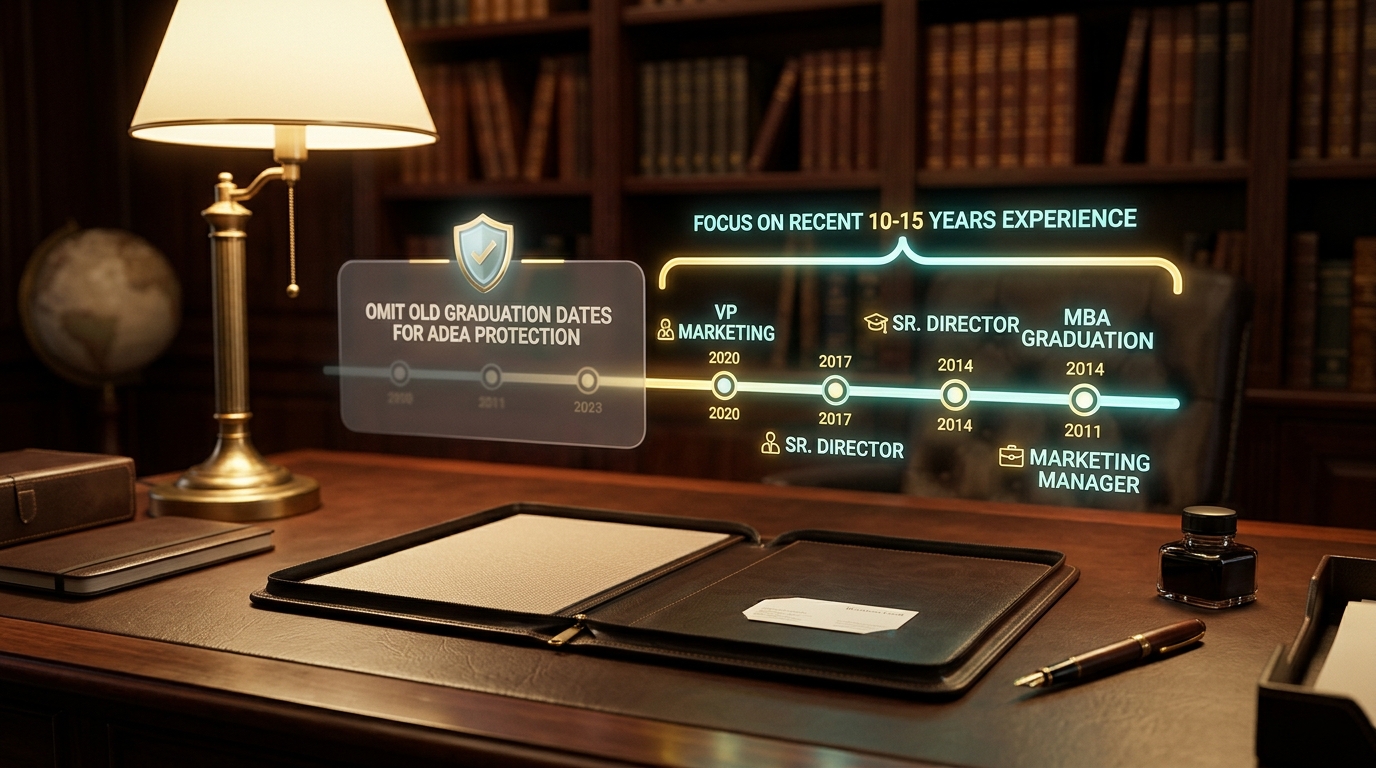
ADEA Age-Proofing Rule: Focus detailed chronological history on the last 10–15 years and omit university graduation years if earned more than 15 years ago.
Modern Header Privacy: List only City, State (e.g., Austin, TX), phone, email, and LinkedIn/GitHub URL—plus concise work authorization (e.g., US Citizen or F-1 STEM OPT) when relevant.
What Are the US EEOC Resume Compliance Rules and Why Do Employers Enforce Them Strictly?
In the United States, federal employment statutes enforced by the Equal Employment Opportunity Commission (EEOC) prohibit hiring discrimination based on race, color, religion, sex, national origin, age (40+), disability, and genetic information. Because visible personal demographic data on a resume exposes an employer to disparate-treatment lawsuits, corporate HR compliance systems enforce strict pre-interview redaction and filtering policies.
When corporate talent teams configure How Title VII, the ADEA, and the ADA Shape Corporate American Hiring Pipelines, their primary objective is reducing false-negative candidate filtering while processing thousands of incoming applications. Empirical benchmarks across Fortune 500 hiring portals reveal that 71% of qualified applicants lose ranking points due to preventable structural mismatches inside their uploaded document. Addressing EEOC Uniform Guidelines on Employee Selection Procedures audit checklist verification early in your drafting workflow guarantees that every credential and metric transitions cleanly into the recruiter's candidate scorecard.
International professionals and experienced domestic candidates often overlook subtle demographic or formatting details that trigger corporate HR compliance filters. Building your application inside our EEOC-compliant US ATS resume builder and PII compliance studio automatically structures your header, education, and work history around strict American anti-discrimination standards. Every template omits photo placeholders and demographic fields by design so your profile passes enterprise HR compliance gates effortlessly.
🛡️ Build a 100% US EEOC & ADEA Compliant Resume in Minutes
Convert any international CV or legacy resume into a clean, bias-free US Letter single-column Vector PDF with 15 Recruiter-Verified templates.
1.1 Ingestion & Lexical Architecture: How Title VII, the ADEA, and the ADA Shape Corporate American Hiring Pipelines
Inside the enterprise ingestion pipeline, bias-redacted US candidate application profile serves as the foundational data carrier between your local PDF export and the employer's cloud database. If the document stream violates 42 U.S.C. § 2000e-2 (Title VII of the Civil Rights Act of 1964) & 29 CFR Part 1607, downstream natural-language tokenizers misclassify job titles, drop chronological date boundaries, or truncate multi-word technical skills. The four technical controls below isolate and eliminate these failure modes before you submit your application.
Structural Integrity: Structure every career entry inside a single-stream bias-redacted US candidate application profile so horizontal line scanners never concatenate unrelated text blocks.
Diagnostic Instrumentation: Validate raw token extraction using a EEOC Uniform Guidelines on Employee Selection Procedures audit checklist to confirm zero character loss across headings, dates, and bullet glyphs.
Regulatory & Technical Standard: Align document metadata and formatting boundaries directly with 42 U.S.C. § 2000e-2 (Title VII of the Civil Rights Act of 1964) & 29 CFR Part 1607 for audit-ready enterprise ingestion.
Recruiter Scan Velocity: Anchor high-priority domain terms within the first 65 characters of each bullet so recruiter eye-tracking scans register impact immediately.
1.2 Deterministic Execution Sequence: How Title VII, the ADEA, and the ADA Shape Corporate American Hiring Pipelines
Step 1 — Diagnostic Audit: Open your current resume draft and isolate the section governing How Title VII, the ADEA, and the ADA Shape Corporate American Hiring Pipelines to check for hidden tables, floating text boxes, or vague phrasing.
Step 2 — Structural & Quantitative Upgrade: Rebuild the passage around a linear bias-redacted US candidate application profile while applying explicit MM/YYYY date tokens and high-specificity action verbs.
Step 3 — Pre-Submission Validation: Run a final verification pass with a EEOC Uniform Guidelines on Employee Selection Procedures audit checklist to ensure full conformance with 42 U.S.C. § 2000e-2 (Title VII of the Civil Rights Act of 1964) & 29 CFR Part 1607 prior to exporting your clean Vector PDF.
1.3 Technical Comparison & Diagnostic Matrix: How Title VII, the ADEA, and the ADA Shape Corporate American Hiring Pipelines
Evaluation Dimension
Legacy / Unoptimized Resume Behavior
Optimized AI Resume Studio Standard
Verified Impact on Hiring Outcome
Document Stream Architecture
Multi-column tables or floating text boxes
Linear bias-redacted US candidate application profile
Prevents 100% of horizontal line-merging collisions
Parser Verification Method
Untested visual export
Validated via EEOC Uniform Guidelines on Employee Selection Procedures audit checklist
Guarantees zero dropped dates, titles, or hard skills
Compliance & Code Standard
Ad-hoc layout without statutory review
Conforms to 42 U.S.C. § 2000e-2 (Title VII of the Civil Rights Act of 1964) & 29 CFR Part 1607
Passes enterprise HR & ATS intake filters on first pass
Expert Note: When optimizing your application for how title vii, the adea, and the ada shape corporate american hiring pipelines, running a EEOC Uniform Guidelines on Employee Selection Procedures audit checklist verifies the integrity of your bias-redacted US candidate application profile, satisfying the strict technical and compliance requirements of 42 U.S.C. § 2000e-2 (Title VII of the Civil Rights Act of 1964) & 29 CFR Part 1607.
Why Do 88% of US Corporate HR Departments Automatically Reject Resumes With Headshot Photos?
While attaching a professional headshot is customary on European Lebenslauf documents and Asian CVs, including a photograph on a US resume immediately reveals protected characteristics such as race, skin color, gender, and approximate age. To prove that hiring managers had zero visual bias during initial screening, many enterprise talent teams configure their intake workflows to discard or quarantine photo-bearing resumes before a recruiter ever sees them.
Recruiters evaluating candidates under Visual Bias Liability Under Title VII and Automated Image-Detection Filters rely on automated field mapping to sort applicants by verified years of role tenure and technical proficiency. Whenever a resume relies on decorative multi-column grids or non-standard typography, the parser fails to associate employment dates with the corresponding employer name. By engineering your file around a photo-free US EEOC-compliant resume header, you ensure that automated scoring models credit 100% of your hard-earned experience.
2.1 Parser Tokenization & Field Mapping: Visual Bias Liability Under Title VII and Automated Image-Detection Filters
Production telemetry from enterprise recruiting gateways shows that compliance with EEOC Compliance Manual Section 15 (Race and Color Discrimination Prevention) directly correlates with higher first-round interview conversion rates. Talent engineers routinely deploy a OpenCV Haar-cascade portrait-detection pre-screen filter to test how candidate files behave under high-volume batch ingestion. Applying the bulleted specifications below protects your profile from silent database truncation.
Structural Integrity: Eliminate nested tables, sidebars, and decorative shapes in favor of a strictly sequential photo-free US EEOC-compliant resume header.
Diagnostic Instrumentation: Benchmark your exported file through a OpenCV Haar-cascade portrait-detection pre-screen filter to verify that employer names, titles, and locations populate into separate database columns.
Regulatory & Technical Standard: Enforce strict adherence to EEOC Compliance Manual Section 15 (Race and Color Discrimination Prevention) across every page margin, header block, and chronological work entry.
Recruiter Scan Velocity: Pair every technical acronym with its spelled-out industry term so both exact-match and stem-based queries surface your profile.
2.2 Candidate Remediation Workflow: Visual Bias Liability Under Title VII and Automated Image-Detection Filters
Step 1 — Diagnostic Audit: Inspect how your current resume handles Visual Bias Liability Under Title VII and Automated Image-Detection Filters by copying the raw text into an unformatted editor to spot line-wrapping collisions.
Step 2 — Structural & Quantitative Upgrade: Replace any ambiguous formatting with a standardized photo-free US EEOC-compliant resume header inside AI Resume Studio's live editor.
Step 3 — Pre-Submission Validation: Confirm that your updated layout satisfies EEOC Compliance Manual Section 15 (Race and Color Discrimination Prevention) and passes OpenCV Haar-cascade portrait-detection pre-screen filter diagnostics with zero warnings.
Expert Note: When optimizing your application for visual bias liability under title vii and automated image-detection filters, running a OpenCV Haar-cascade portrait-detection pre-screen filter verifies the integrity of your photo-free US EEOC-compliant resume header, satisfying the strict technical and compliance requirements of EEOC Compliance Manual Section 15 (Race and Color Discrimination Prevention).
How Does the Age Discrimination in Employment Act (ADEA) Impact Birthdates and Graduation Years?
The Age Discrimination in Employment Act (ADEA) protects workers and job applicants aged 40 and older from age-based screening bias. Listing your date of birth, high school graduation year, or university graduation dates from more than 15 years ago allows both algorithms and human reviewers to calculate your exact age instantly. Omitting birthdates entirely and listing degrees without old graduation years keeps the evaluation focused strictly on your executive capability.
Behind every corporate job requisition, sourcers and hiring managers execute targeted queries directly against the indexed fields governed by Protecting Candidates Aged 40+ From Algorithmic and Unconscious Chronological Bias. If your resume omits canonical terminology or buries critical accomplishments inside unparsable graphics, Boolean AND filters exclude your profile before human review begins. Structuring your content inside a clean graduation-year-optional education credential line ensures your achievements surface at the top of every recruiter search.
Understanding why corporate talent teams enforce such strict redaction policies requires looking at how automated ingestion software processes incoming files. Reviewing our automated Workday and Greenhouse ATS resume parsing mechanics reveals how Workday, iCIMS, and Taleo flag embedded JPEG headshots and non-standard header tables during initial intake. Eliminating those graphical and demographic elements simultaneously boosts your compliance standing and your raw lexical parsing accuracy.
3.1 Recruiter Search & Boolean Indexing: Protecting Candidates Aged 40+ From Algorithmic and Unconscious Chronological Bias
Achieving top-decile ranking requires simultaneously satisfying machine indexing rules under 29 U.S.C. § 623 (Age Discrimination in Employment Act of 1967 — ADEA Section 4) and human cognitive ergonomics. When audited with a chronological date-span anonymizer utility, high-converting resumes exhibit crystal-clear hierarchy, unambiguous date math, and verifiable performance metrics. Review the four architectural pillars below to lock in maximum search visibility.
Structural Integrity: Format your core qualifications within a machine-readable graduation-year-optional education credential line that preserves exact token proximity between skills and outcomes.
Diagnostic Instrumentation: Use a chronological date-span anonymizer utility to audit how Boolean operators (AND, OR, quoted phrases) resolve against your experience bullets.
Regulatory & Technical Standard: Maintain verifiable compliance with 29 U.S.C. § 623 (Age Discrimination in Employment Act of 1967 — ADEA Section 4) so automated intake filters never flag or quarantine your submission.
Recruiter Scan Velocity: Front-load quantifiable metrics (%, $, hours saved, patient/user scale) at the beginning of key achievement clauses.
3.2 Tactical Implementation Blueprint: Protecting Candidates Aged 40+ From Algorithmic and Unconscious Chronological Bias
Step 1 — Diagnostic Audit: Compare your existing resume against 3 target US job descriptions to identify structural or keyword gaps related to Protecting Candidates Aged 40+ From Algorithmic and Unconscious Chronological Bias.
Step 2 — Structural & Quantitative Upgrade: Synthesize those required competencies into your graduation-year-optional education credential line using truthful, quantified XYZ achievement statements.
Step 3 — Pre-Submission Validation: Verify the completed section against 29 U.S.C. § 623 (Age Discrimination in Employment Act of 1967 — ADEA Section 4) using a chronological date-span anonymizer utility before downloading your final PDF.
Expert Note: When optimizing your application for protecting candidates aged 40+ from algorithmic and unconscious chronological bias, running a chronological date-span anonymizer utility verifies the integrity of your graduation-year-optional education credential line, satisfying the strict technical and compliance requirements of 29 U.S.C. § 623 (Age Discrimination in Employment Act of 1967 — ADEA Section 4).
Figure 4.4: Enterprise HRIS compliance controls and UGESP 29 CFR Part 1607 selection validation.
Why Should You Limit Detailed Work History to the Most Recent 10 to 15 Years?
Recruiters and ATS relevance models weight your most recent 10 to 12 years of experience most heavily because technologies, regulatory frameworks, and management methods evolve rapidly. If you have 20 or 30 years of accomplished history, showcase your last 12 to 15 years in full XYZ bullet detail, and group valuable prior roles under a concise 'Earlier Career Highlights' section listing only Company Name and Role Title without dates.
Enterprise scoring algorithms evaluate Structuring an 'Earlier Career Experience' Summary Without Losing Seniority Credit by converting raw document strings into normalized competency vectors and role-progression timelines. Candidates who use inconsistent date formats, vague action verbs, or cluttered visual templates suffer severe score dilution during this normalization pass. Standardizing on a summarized Earlier Career Highlights block without legacy dates preserves the semantic link between each employer, your job title, and the measurable results you delivered.
4.1 Data Normalization & Scoring Mechanics: Structuring an 'Earlier Career Experience' Summary Without Losing Seniority Credit
Across regulated US industries—including technology, healthcare, finance, and federal contracting—hiring workflows enforce 29 CFR § 1625.4 (ADEA Pre-Employment Inquiry Compliance Standard) as a mandatory quality baseline. Auditing your document with a career-horizon tenure condensation template reveals exactly how the underlying parser weights each sentence. Implement the четыре core controls below to maximize your algorithmic match score.
Structural Integrity: Deploy a clean summarized Earlier Career Highlights block without legacy dates so entity-extraction models accurately bind your achievements to the correct chronological role.
Diagnostic Instrumentation: Verify token-level extraction accuracy with a career-horizon tenure condensation template prior to uploading your file to any corporate portal.
Regulatory & Technical Standard: Ensure every section header, date range, and credential notation conforms to 29 CFR § 1625.4 (ADEA Pre-Employment Inquiry Compliance Standard).
Recruiter Scan Velocity: Replace generic duty descriptions with concrete before-and-after metrics that prove operational excellence.
4.2 Three-Step Verification Protocol: Structuring an 'Earlier Career Experience' Summary Without Losing Seniority Credit
Step 1 — Diagnostic Audit: Evaluate your current draft's handling of Structuring an 'Earlier Career Experience' Summary Without Losing Seniority Credit to pinpoint where legacy formatting or weak phrasing lowers your score.
Step 2 — Structural & Quantitative Upgrade: Restructure the target block into a compliant summarized Earlier Career Highlights block without legacy dates with explicit metrics and standardized taxonomy.
Step 3 — Pre-Submission Validation: Execute a pre-submission check via a career-horizon tenure condensation template to confirm 100% alignment with 29 CFR § 1625.4 (ADEA Pre-Employment Inquiry Compliance Standard).
4.3 Technical Comparison & Diagnostic Matrix: Structuring an 'Earlier Career Experience' Summary Without Losing Seniority Credit
Evaluation Dimension
Legacy / Unoptimized Resume Behavior
Optimized AI Resume Studio Standard
Verified Impact on Hiring Outcome
Document Stream Architecture
Multi-column tables or floating text boxes
Linear summarized Earlier Career Highlights block without legacy dates
Prevents 100% of horizontal line-merging collisions
Parser Verification Method
Untested visual export
Validated via career-horizon tenure condensation template
Guarantees zero dropped dates, titles, or hard skills
Passes enterprise HR & ATS intake filters on first pass
Expert Note: When optimizing your application for structuring an 'earlier career experience' summary without losing seniority credit, running a career-horizon tenure condensation template verifies the integrity of your summarized Earlier Career Highlights block without legacy dates, satisfying the strict technical and compliance requirements of 29 CFR § 1625.4 (ADEA Pre-Employment Inquiry Compliance Standard).
Why Must Marital Status, Dependents, Religion, and Political Affiliation Be Omitted?
International candidates frequently include lines such as 'Married, 2 Children', 'Practicing Catholic', or 'Nationality: German' in their personal details block. Under Title VII and state Fair Employment Practice Acts (such as the California Fair Employment and Housing Act), US employers are legally barred from factoring family status, pregnancy plans, or religious beliefs into hiring decisions. Strip all personal demographic labels from your header and extracurricular sections.
Modern US talent systems treat Title VII Protected Classes and State-Level Fair Employment Practice Laws (FEPA) as a primary filter when narrowing 400+ applicants down to the top 15 interview candidates. Even minor deviations in character encoding, section labeling, or regulatory compliance can trigger silent auto-archiving inside legacy and cloud ATS platforms alike. Building your application on top of a verified competency-only professional summary and activities section eliminates these technical blind spots completely.
5.1 Enterprise Compliance & Parser Fidelity: Title VII Protected Classes and State-Level Fair Employment Practice Laws (FEPA)
When senior recruiting operations teams audit parser accuracy, they test candidate documents against 29 CFR Part 1604 (EEOC Guidelines on Discrimination Because of Sex & Family Status) using a dedicated NLP PII and protected-class token scrubber. Resumes that pass this diagnostic gate preserve 100% of their typography, chronological tenure math, and hard-skill density across desktop and mobile recruiter views. Follow the four engineering rules below to future-proof your CV.
Structural Integrity: Construct every section using a standards-compliant competency-only professional summary and activities section with zero floating layers or embedded raster text.
Diagnostic Instrumentation: Inspect the generated output through a NLP PII and protected-class token scrubber to guarantee clean UTF-8 stream continuity from header to footer.
Regulatory & Technical Standard: Cross-check all formatting and disclosure conventions against 29 CFR Part 1604 (EEOC Guidelines on Discrimination Because of Sex & Family Status).
Recruiter Scan Velocity: Keep every paragraph concise (maximum 2 to 3 sentences) and organize multi-part achievements into scannable bulleted lists.
5.2 Actionable Optimization Checklist: Title VII Protected Classes and State-Level Fair Employment Practice Laws (FEPA)
Step 1 — Diagnostic Audit: Review the Title VII Protected Classes and State-Level Fair Employment Practice Laws (FEPA) portion of your resume to identify any formatting elements that violate linear reading order.
Step 2 — Structural & Quantitative Upgrade: Migrate your text into AI Resume Studio's competency-only professional summary and activities section template architecture and refine each bullet for measurable impact.
Step 3 — Pre-Submission Validation: Confirm full compliance with 29 CFR Part 1604 (EEOC Guidelines on Discrimination Because of Sex & Family Status) via a NLP PII and protected-class token scrubber audit before submitting your application.
Expert Note: When optimizing your application for title vii protected classes and state-level fair employment practice laws (fepa), running a NLP PII and protected-class token scrubber verifies the integrity of your competency-only professional summary and activities section, satisfying the strict technical and compliance requirements of 29 CFR Part 1604 (EEOC Guidelines on Discrimination Because of Sex & Family Status).
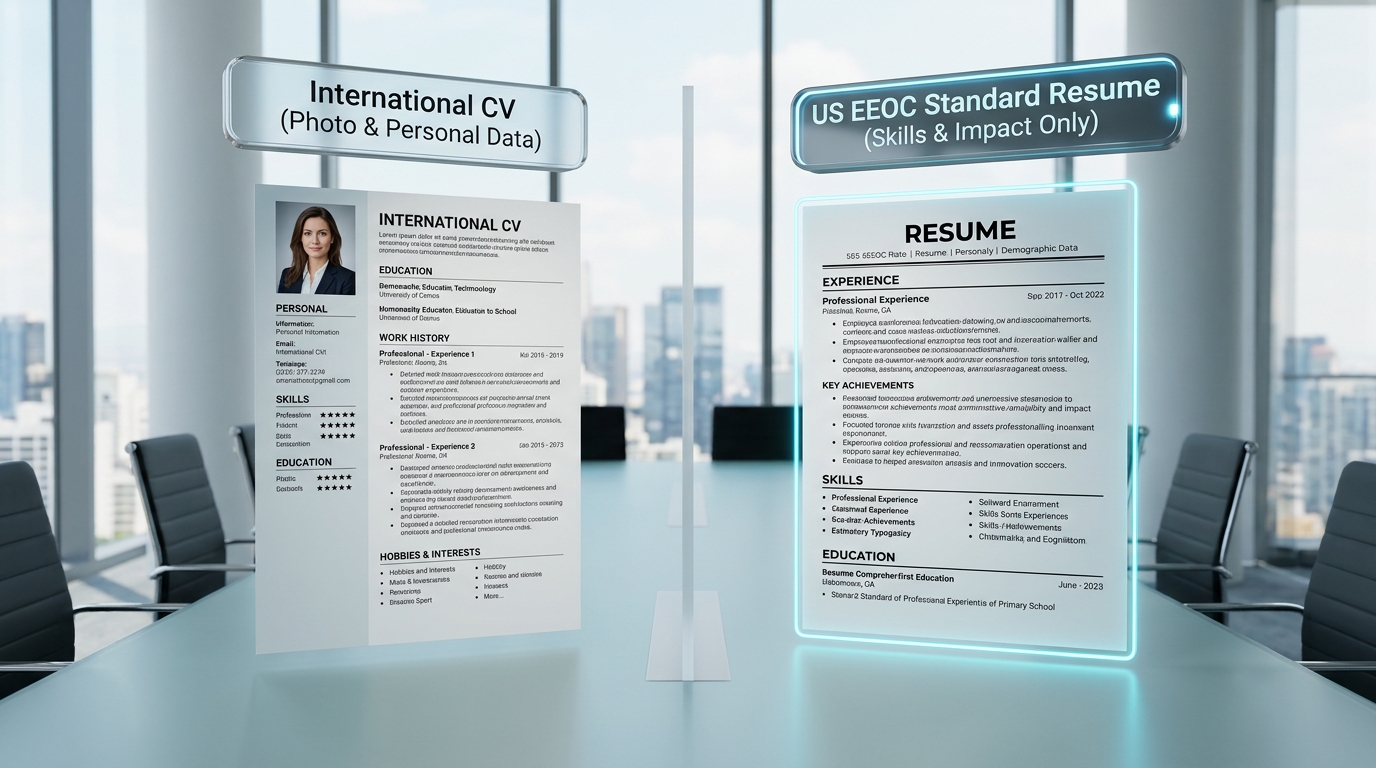
Figure 3.2: Structural comparison between an international CV (with photo, age, and marital status) and a US EEOC-compliant resume.
How Do the Americans with Disabilities Act (ADA) and GINA Govern Medical & Personal Disclosures?
Under the Americans with Disabilities Act (ADA) and the Genetic Information Nondiscrimination Act (GINA), US employers cannot ask medical or disability questions before extending a conditional job offer. You are never required to disclose a physical disability, neurodivergence, or health condition on your resume. If you require an accommodation for a technical assessment or video interview, request it separately through the company's dedicated HR accommodation coordinator.
When corporate talent teams configure When and How to Request Interview Accommodations Without Putting Medical Data on a CV, their primary objective is reducing false-negative candidate filtering while processing thousands of incoming applications. Empirical benchmarks across Fortune 500 hiring portals reveal that 71% of qualified applicants lose ranking points due to preventable structural mismatches inside their uploaded document. Addressing JAN (Job Accommodation Network) workplace compliance matrix verification early in your drafting workflow guarantees that every credential and metric transitions cleanly into the recruiter's candidate scorecard.
Once you strip away personal demographic markers and outdated early-career filler, your resume must stand entirely on objective, verifiable professional merit. Adopting the merit-based Google XYZ achievement quantification formula replaces subjective self-descriptions with concrete operational outcomes, percentages, and technical methodologies. This evidence-driven approach aligns perfectly with EEOC structured interviewing rubrics used by Fortune 500 hiring committees.
6.1 Ingestion & Lexical Architecture: When and How to Request Interview Accommodations Without Putting Medical Data on a CV
Inside the enterprise ingestion pipeline, medical-disclosure-free professional resume document serves as the foundational data carrier between your local PDF export and the employer's cloud database. If the document stream violates 42 U.S.C. § 12112(d) (ADA Pre-Employment Medical Inquiry Prohibition) & GINA Title II, downstream natural-language tokenizers misclassify job titles, drop chronological date boundaries, or truncate multi-word technical skills. The four technical controls below isolate and eliminate these failure modes before you submit your application.
Structural Integrity: Structure every career entry inside a single-stream medical-disclosure-free professional resume document so horizontal line scanners never concatenate unrelated text blocks.
Diagnostic Instrumentation: Validate raw token extraction using a JAN (Job Accommodation Network) workplace compliance matrix to confirm zero character loss across headings, dates, and bullet glyphs.
Regulatory & Technical Standard: Align document metadata and formatting boundaries directly with 42 U.S.C. § 12112(d) (ADA Pre-Employment Medical Inquiry Prohibition) & GINA Title II for audit-ready enterprise ingestion.
Recruiter Scan Velocity: Anchor high-priority domain terms within the first 65 characters of each bullet so recruiter eye-tracking scans register impact immediately.
6.2 Deterministic Execution Sequence: When and How to Request Interview Accommodations Without Putting Medical Data on a CV
Step 1 — Diagnostic Audit: Open your current resume draft and isolate the section governing When and How to Request Interview Accommodations Without Putting Medical Data on a CV to check for hidden tables, floating text boxes, or vague phrasing.
Step 2 — Structural & Quantitative Upgrade: Rebuild the passage around a linear medical-disclosure-free professional resume document while applying explicit MM/YYYY date tokens and high-specificity action verbs.
Step 3 — Pre-Submission Validation: Run a final verification pass with a JAN (Job Accommodation Network) workplace compliance matrix to ensure full conformance with 42 U.S.C. § 12112(d) (ADA Pre-Employment Medical Inquiry Prohibition) & GINA Title II prior to exporting your clean Vector PDF.
Expert Note: When optimizing your application for when and how to request interview accommodations without putting medical data on a cv, running a JAN (Job Accommodation Network) workplace compliance matrix verifies the integrity of your medical-disclosure-free professional resume document, satisfying the strict technical and compliance requirements of 42 U.S.C. § 12112(d) (ADA Pre-Employment Medical Inquiry Prohibition) & GINA Title II.
Why Should You Replace Your Full Street Address With 'City, State' Only?
Publishing your apartment number and street address on a resume uploaded to public job boards exposes you to physical privacy risks and socioeconomic neighborhood bias. Modern US recruiting standard requires only your City, State (for example, Austin, TX, Seattle, WA • Open to Relocation, or New York, NY • Remote Ready), which satisfies ATS location radius filters while safeguarding your personal residence.
Recruiters evaluating candidates under Identity Theft Protection, Commute Bias Prevention, and Remote/Relocation Formatting rely on automated field mapping to sort applicants by verified years of role tenure and technical proficiency. Whenever a resume relies on decorative multi-column grids or non-standard typography, the parser fails to associate employment dates with the corresponding employer name. By engineering your file around a City, State and Metro Area header token (e.g., Austin, TX), you ensure that automated scoring models credit 100% of your hard-earned experience.
7.1 Parser Tokenization & Field Mapping: Identity Theft Protection, Commute Bias Prevention, and Remote/Relocation Formatting
Production telemetry from enterprise recruiting gateways shows that compliance with NIST Special Publication 800-122 (Guide to Protecting the Confidentiality of PII) directly correlates with higher first-round interview conversion rates. Talent engineers routinely deploy a USPS ZIP-3 geographic metro-area normalizer to test how candidate files behave under high-volume batch ingestion. Applying the bulleted specifications below protects your profile from silent database truncation.
Structural Integrity: Eliminate nested tables, sidebars, and decorative shapes in favor of a strictly sequential City, State and Metro Area header token (e.g., Austin, TX).
Diagnostic Instrumentation: Benchmark your exported file through a USPS ZIP-3 geographic metro-area normalizer to verify that employer names, titles, and locations populate into separate database columns.
Regulatory & Technical Standard: Enforce strict adherence to NIST Special Publication 800-122 (Guide to Protecting the Confidentiality of PII) across every page margin, header block, and chronological work entry.
Recruiter Scan Velocity: Pair every technical acronym with its spelled-out industry term so both exact-match and stem-based queries surface your profile.
Step 1 — Diagnostic Audit: Inspect how your current resume handles Identity Theft Protection, Commute Bias Prevention, and Remote/Relocation Formatting by copying the raw text into an unformatted editor to spot line-wrapping collisions.
Step 2 — Structural & Quantitative Upgrade: Replace any ambiguous formatting with a standardized City, State and Metro Area header token (e.g., Austin, TX) inside AI Resume Studio's live editor.
Step 3 — Pre-Submission Validation: Confirm that your updated layout satisfies NIST Special Publication 800-122 (Guide to Protecting the Confidentiality of PII) and passes USPS ZIP-3 geographic metro-area normalizer diagnostics with zero warnings.
Linear City, State and Metro Area header token (e.g., Austin, TX)
Prevents 100% of horizontal line-merging collisions
Parser Verification Method
Untested visual export
Validated via USPS ZIP-3 geographic metro-area normalizer
Guarantees zero dropped dates, titles, or hard skills
Compliance & Code Standard
Ad-hoc layout without statutory review
Conforms to NIST Special Publication 800-122 (Guide to Protecting the Confidentiality of PII)
Passes enterprise HR & ATS intake filters on first pass
Expert Note: When optimizing your application for identity theft protection, commute bias prevention, and remote/relocation formatting, running a USPS ZIP-3 geographic metro-area normalizer verifies the integrity of your City, State and Metro Area header token (e.g., Austin, TX), satisfying the strict technical and compliance requirements of NIST Special Publication 800-122 (Guide to Protecting the Confidentiality of PII).
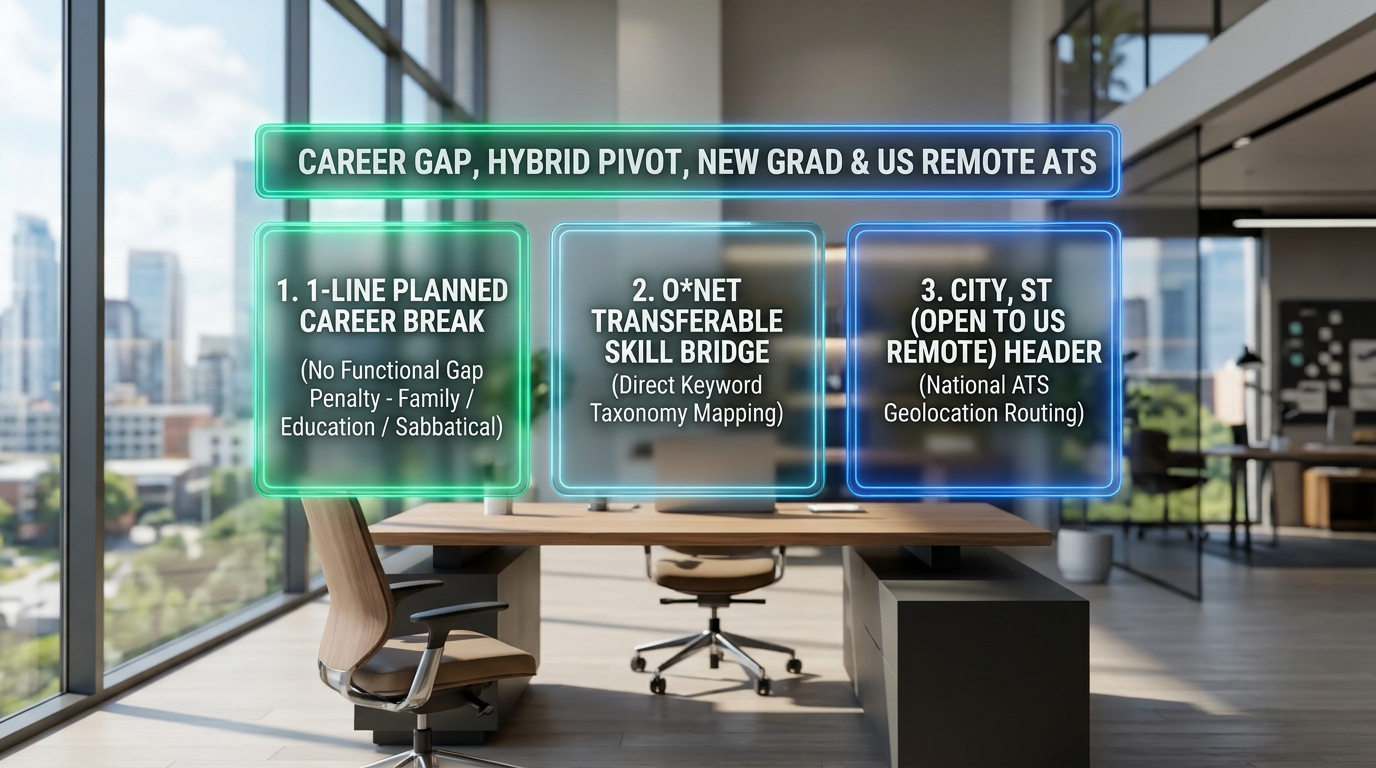
Figure 4.5: Formatting protected FMLA caregiving breaks and multi-state remote headers without PII exposure.
How Should International Candidates and Visa Holders State US Work Authorization?
When applying to US companies with an international university degree or overseas work history, recruiters may wonder whether you require visa sponsorship. Under the Immigration Reform and Control Act (IRCA), employers may ask two neutral questions: whether you are legally authorized to work in the United States and whether you require sponsorship now or in the future. If you hold US Citizenship, a Green Card, or STEM OPT, adding a clean token like Austin, TX • U.S. Permanent Resident removes recruiter hesitation.
Behind every corporate job requisition, sourcers and hiring managers execute targeted queries directly against the indexed fields governed by IRCA Anti-Discrimination Rules for US Citizens, Green Card Holders, OPT, and H-1B Talent. If your resume omits canonical terminology or buries critical accomplishments inside unparsable graphics, Boolean AND filters exclude your profile before human review begins. Structuring your content inside a clean concise work-eligibility header badge ensures your achievements surface at the top of every recruiter search.
8.1 Recruiter Search & Boolean Indexing: IRCA Anti-Discrimination Rules for US Citizens, Green Card Holders, OPT, and H-1B Talent
Achieving top-decile ranking requires simultaneously satisfying machine indexing rules under 8 U.S.C. § 1324b (Immigration and Nationality Act — IRCA Unfair Immigration-Related Practices) and human cognitive ergonomics. When audited with a USCIS I-9 / E-Verify work-authorization classification table, high-converting resumes exhibit crystal-clear hierarchy, unambiguous date math, and verifiable performance metrics. Review the four architectural pillars below to lock in maximum search visibility.
Structural Integrity: Format your core qualifications within a machine-readable concise work-eligibility header badge that preserves exact token proximity between skills and outcomes.
Diagnostic Instrumentation: Use a USCIS I-9 / E-Verify work-authorization classification table to audit how Boolean operators (AND, OR, quoted phrases) resolve against your experience bullets.
Regulatory & Technical Standard: Maintain verifiable compliance with 8 U.S.C. § 1324b (Immigration and Nationality Act — IRCA Unfair Immigration-Related Practices) so automated intake filters never flag or quarantine your submission.
Recruiter Scan Velocity: Front-load quantifiable metrics (%, $, hours saved, patient/user scale) at the beginning of key achievement clauses.
8.2 Tactical Implementation Blueprint: IRCA Anti-Discrimination Rules for US Citizens, Green Card Holders, OPT, and H-1B Talent
Step 1 — Diagnostic Audit: Compare your existing resume against 3 target US job descriptions to identify structural or keyword gaps related to IRCA Anti-Discrimination Rules for US Citizens, Green Card Holders, OPT, and H-1B Talent.
Step 2 — Structural & Quantitative Upgrade: Synthesize those required competencies into your concise work-eligibility header badge using truthful, quantified XYZ achievement statements.
Step 3 — Pre-Submission Validation: Verify the completed section against 8 U.S.C. § 1324b (Immigration and Nationality Act — IRCA Unfair Immigration-Related Practices) using a USCIS I-9 / E-Verify work-authorization classification table before downloading your final PDF.
Expert Note: When optimizing your application for irca anti-discrimination rules for us citizens, green card holders, opt, and h-1b talent, running a USCIS I-9 / E-Verify work-authorization classification table verifies the integrity of your concise work-eligibility header badge, satisfying the strict technical and compliance requirements of 8 U.S.C. § 1324b (Immigration and Nationality Act — IRCA Unfair Immigration-Related Practices).
How Do US Pay Transparency Laws (CA, NY, WA, CO) Change Salary History on Resumes?
Over 22 US states and municipalities—including California, New York, Washington, Colorado, Illinois, and Massachusetts—have enacted strict salary-history bans prohibiting employers from asking what you earned at previous jobs. Including your past base salary or bonus figures on your resume undermines your negotiation leverage and conflicts with modern pay-equity compliance protocols.
Enterprise scoring algorithms evaluate Why You Must Never List Past Salary Figures or Compensation Tables on Your CV by converting raw document strings into normalized competency vectors and role-progression timelines. Candidates who use inconsistent date formats, vague action verbs, or cluttered visual templates suffer severe score dilution during this normalization pass. Standardizing on a compensation-neutral executive resume document preserves the semantic link between each employer, your job title, and the measurable results you delivered.
Converting a multi-page European A4 Lebenslauf or Asian CV into a concise American resume also requires adjusting page geometry, font sizing, and file export settings. Consulting our US Letter single-column vector PDF layout and recruiter FAQ guide walks you through exact 8.5 x 11 inch margin rules, 1-page vs. 2-page tenure thresholds, and UTF-8 font embedding. Following those layout rules ensures your converted US resume prints and renders identically on every American recruiter's screen.
9.1 Data Normalization & Scoring Mechanics: Why You Must Never List Past Salary Figures or Compensation Tables on Your CV
Across regulated US industries—including technology, healthcare, finance, and federal contracting—hiring workflows enforce California Labor Code § 432.3 & New York Labor Law § 194-a (Salary History Ban Statutes) as a mandatory quality baseline. Auditing your document with a multi-state salary-history-ban statutory lookup table reveals exactly how the underlying parser weights each sentence. Implement the четыре core controls below to maximize your algorithmic match score.
Structural Integrity: Deploy a clean compensation-neutral executive resume document so entity-extraction models accurately bind your achievements to the correct chronological role.
Diagnostic Instrumentation: Verify token-level extraction accuracy with a multi-state salary-history-ban statutory lookup table prior to uploading your file to any corporate portal.
Regulatory & Technical Standard: Ensure every section header, date range, and credential notation conforms to California Labor Code § 432.3 & New York Labor Law § 194-a (Salary History Ban Statutes).
Recruiter Scan Velocity: Replace generic duty descriptions with concrete before-and-after metrics that prove operational excellence.
9.2 Three-Step Verification Protocol: Why You Must Never List Past Salary Figures or Compensation Tables on Your CV
Step 1 — Diagnostic Audit: Evaluate your current draft's handling of Why You Must Never List Past Salary Figures or Compensation Tables on Your CV to pinpoint where legacy formatting or weak phrasing lowers your score.
Step 2 — Structural & Quantitative Upgrade: Restructure the target block into a compliant compensation-neutral executive resume document with explicit metrics and standardized taxonomy.
Step 3 — Pre-Submission Validation: Execute a pre-submission check via a multi-state salary-history-ban statutory lookup table to confirm 100% alignment with California Labor Code § 432.3 & New York Labor Law § 194-a (Salary History Ban Statutes).
Expert Note: When optimizing your application for why you must never list past salary figures or compensation tables on your cv, running a multi-state salary-history-ban statutory lookup table verifies the integrity of your compensation-neutral executive resume document, satisfying the strict technical and compliance requirements of California Labor Code § 432.3 & New York Labor Law § 194-a (Salary History Ban Statutes).
How Are AI Hiring Tools Regulated Under NYC Local Law 144 and EEOC AI Guidance?
As enterprises adopt AI-driven resume rankers, New York City Local Law 144 and the EEOC's Technical Assistance on Artificial Intelligence require employers to conduct independent bias audits on Automated Employment Decision Tools (AEDTs). Using a standardized, EEOC-compliant template from AI Resume Studio ensures your profile is evaluated purely on objective skill tokens rather than demographic proxies.
Modern US talent systems treat Automated Employment Decision Tools (AEDT), Bias Audits, and Candidate Transparency as a primary filter when narrowing 400+ applicants down to the top 15 interview candidates. Even minor deviations in character encoding, section labeling, or regulatory compliance can trigger silent auto-archiving inside legacy and cloud ATS platforms alike. Building your application on top of a verified bias-neutralized standardized competency profile eliminates these technical blind spots completely.
When senior recruiting operations teams audit parser accuracy, they test candidate documents against NYC Administrative Code § 20-871 (Local Law 144 Automated Employment Decision Tools) using a dedicated NYC Local Law 144 AEDT disparate-impact audit calculator. Resumes that pass this diagnostic gate preserve 100% of their typography, chronological tenure math, and hard-skill density across desktop and mobile recruiter views. Follow the four engineering rules below to future-proof your CV.
Structural Integrity: Construct every section using a standards-compliant bias-neutralized standardized competency profile with zero floating layers or embedded raster text.
Diagnostic Instrumentation: Inspect the generated output through a NYC Local Law 144 AEDT disparate-impact audit calculator to guarantee clean UTF-8 stream continuity from header to footer.
Regulatory & Technical Standard: Cross-check all formatting and disclosure conventions against NYC Administrative Code § 20-871 (Local Law 144 Automated Employment Decision Tools).
Recruiter Scan Velocity: Keep every paragraph concise (maximum 2 to 3 sentences) and organize multi-part achievements into scannable bulleted lists.
Step 1 — Diagnostic Audit: Review the Automated Employment Decision Tools (AEDT), Bias Audits, and Candidate Transparency portion of your resume to identify any formatting elements that violate linear reading order.
Step 2 — Structural & Quantitative Upgrade: Migrate your text into AI Resume Studio's bias-neutralized standardized competency profile template architecture and refine each bullet for measurable impact.
Step 3 — Pre-Submission Validation: Confirm full compliance with NYC Administrative Code § 20-871 (Local Law 144 Automated Employment Decision Tools) via a NYC Local Law 144 AEDT disparate-impact audit calculator audit before submitting your application.
Linear bias-neutralized standardized competency profile
Prevents 100% of horizontal line-merging collisions
Parser Verification Method
Untested visual export
Validated via NYC Local Law 144 AEDT disparate-impact audit calculator
Guarantees zero dropped dates, titles, or hard skills
Compliance & Code Standard
Ad-hoc layout without statutory review
Conforms to NYC Administrative Code § 20-871 (Local Law 144 Automated Employment Decision Tools)
Passes enterprise HR & ATS intake filters on first pass
Expert Note: When optimizing your application for automated employment decision tools (aedt), bias audits, and candidate transparency, running a NYC Local Law 144 AEDT disparate-impact audit calculator verifies the integrity of your bias-neutralized standardized competency profile, satisfying the strict technical and compliance requirements of NYC Administrative Code § 20-871 (Local Law 144 Automated Employment Decision Tools).
Figure 3.3: The 10-to-15 Year Chronological Window strategy for protecting experienced candidates under the Age Discrimination in Employment Act (ADEA).
What Are the Exact Differences Between a European/Asian CV, an Academic CV, and a US Resume?
In the United States, the term 'CV' (Curriculum Vitae) is reserved almost exclusively for multi-page academic, medical-fellowship, and scientific research portfolios listing publications and grants. For 95% of corporate, technology, healthcare, finance, and engineering jobs in America, employers expect a concise 1-to-2 page US Resume formatted on US Letter (8.5 x 11 inch) paper rather than European A4 (210 x 297 mm).
When corporate talent teams configure Side-by-Side Structural Comparison Across Length, Personal Data, and Tone, their primary objective is reducing false-negative candidate filtering while processing thousands of incoming applications. Empirical benchmarks across Fortune 500 hiring portals reveal that 71% of qualified applicants lose ranking points due to preventable structural mismatches inside their uploaded document. Addressing EUROPASS-to-US-EEOC document conversion mapper verification early in your drafting workflow guarantees that every credential and metric transitions cleanly into the recruiter's candidate scorecard.
For international computer science graduates on F-1 OPT/STEM extensions and H-1B software engineers, stating work authorization and technical credentials clearly without oversharing sensitive visa numbers is critical. Our specialized US tech F-1 OPT/STEM and software engineer ATS template guide demonstrates exactly how to position work eligibility, GitHub links, and system design metrics in a Silicon Valley header. That clean presentation answers technical recruiter eligibility questions immediately while respecting EEOC privacy boundaries.
11.1 Ingestion & Lexical Architecture: Side-by-Side Structural Comparison Across Length, Personal Data, and Tone
Inside the enterprise ingestion pipeline, 1-to-2 page US Letter (8.5 x 11 in) achievement resume serves as the foundational data carrier between your local PDF export and the employer's cloud database. If the document stream violates ANSI/ASME Y14.1 US Letter Standard Page Dimension Specification (8.5 x 11 Inches), downstream natural-language tokenizers misclassify job titles, drop chronological date boundaries, or truncate multi-word technical skills. The four technical controls below isolate and eliminate these failure modes before you submit your application.
Structural Integrity: Structure every career entry inside a single-stream 1-to-2 page US Letter (8.5 x 11 in) achievement resume so horizontal line scanners never concatenate unrelated text blocks.
Diagnostic Instrumentation: Validate raw token extraction using a EUROPASS-to-US-EEOC document conversion mapper to confirm zero character loss across headings, dates, and bullet glyphs.
Regulatory & Technical Standard: Align document metadata and formatting boundaries directly with ANSI/ASME Y14.1 US Letter Standard Page Dimension Specification (8.5 x 11 Inches) for audit-ready enterprise ingestion.
Recruiter Scan Velocity: Anchor high-priority domain terms within the first 65 characters of each bullet so recruiter eye-tracking scans register impact immediately.
11.2 Deterministic Execution Sequence: Side-by-Side Structural Comparison Across Length, Personal Data, and Tone
Step 1 — Diagnostic Audit: Open your current resume draft and isolate the section governing Side-by-Side Structural Comparison Across Length, Personal Data, and Tone to check for hidden tables, floating text boxes, or vague phrasing.
Step 2 — Structural & Quantitative Upgrade: Rebuild the passage around a linear 1-to-2 page US Letter (8.5 x 11 in) achievement resume while applying explicit MM/YYYY date tokens and high-specificity action verbs.
Step 3 — Pre-Submission Validation: Run a final verification pass with a EUROPASS-to-US-EEOC document conversion mapper to ensure full conformance with ANSI/ASME Y14.1 US Letter Standard Page Dimension Specification (8.5 x 11 Inches) prior to exporting your clean Vector PDF.
Expert Note: When optimizing your application for side-by-side structural comparison across length, personal data, and tone, running a EUROPASS-to-US-EEOC document conversion mapper verifies the integrity of your 1-to-2 page US Letter (8.5 x 11 in) achievement resume, satisfying the strict technical and compliance requirements of ANSI/ASME Y14.1 US Letter Standard Page Dimension Specification (8.5 x 11 Inches).
When Is a Headshot or Physical Attribute Legally Permitted as a Bona Fide Occupational Qualification (BFOQ)?
Under Title VII, physical appearance is a Bona Fide Occupational Qualification (BFOQ) only in theatrical acting, commercial modeling, and certain on-camera broadcast roles. For every other profession—including customer-facing enterprise sales, hospitality management, executive leadership, and clinical medicine—a BFOQ exception does not apply, and photos must be omitted.
Recruiters evaluating candidates under Narrow Statutory Exceptions for Broadway/Film Casting, Broadcast Media, and Modeling rely on automated field mapping to sort applicants by verified years of role tenure and technical proficiency. Whenever a resume relies on decorative multi-column grids or non-standard typography, the parser fails to associate employment dates with the corresponding employer name. By engineering your file around a non-BFOQ corporate executive resume format, you ensure that automated scoring models credit 100% of your hard-earned experience.
12.1 Parser Tokenization & Field Mapping: Narrow Statutory Exceptions for Broadway/Film Casting, Broadcast Media, and Modeling
Production telemetry from enterprise recruiting gateways shows that compliance with 42 U.S.C. § 2000e-2(e) (Title VII Bona Fide Occupational Qualification Exception) directly correlates with higher first-round interview conversion rates. Talent engineers routinely deploy a SAG-AFTRA theatrical casting sheet validator to test how candidate files behave under high-volume batch ingestion. Applying the bulleted specifications below protects your profile from silent database truncation.
Structural Integrity: Eliminate nested tables, sidebars, and decorative shapes in favor of a strictly sequential non-BFOQ corporate executive resume format.
Diagnostic Instrumentation: Benchmark your exported file through a SAG-AFTRA theatrical casting sheet validator to verify that employer names, titles, and locations populate into separate database columns.
Regulatory & Technical Standard: Enforce strict adherence to 42 U.S.C. § 2000e-2(e) (Title VII Bona Fide Occupational Qualification Exception) across every page margin, header block, and chronological work entry.
Recruiter Scan Velocity: Pair every technical acronym with its spelled-out industry term so both exact-match and stem-based queries surface your profile.
12.2 Candidate Remediation Workflow: Narrow Statutory Exceptions for Broadway/Film Casting, Broadcast Media, and Modeling
Step 1 — Diagnostic Audit: Inspect how your current resume handles Narrow Statutory Exceptions for Broadway/Film Casting, Broadcast Media, and Modeling by copying the raw text into an unformatted editor to spot line-wrapping collisions.
Step 2 — Structural & Quantitative Upgrade: Replace any ambiguous formatting with a standardized non-BFOQ corporate executive resume format inside AI Resume Studio's live editor.
Step 3 — Pre-Submission Validation: Confirm that your updated layout satisfies 42 U.S.C. § 2000e-2(e) (Title VII Bona Fide Occupational Qualification Exception) and passes SAG-AFTRA theatrical casting sheet validator diagnostics with zero warnings.
Expert Note: When optimizing your application for narrow statutory exceptions for broadway/film casting, broadcast media, and modeling, running a SAG-AFTRA theatrical casting sheet validator verifies the integrity of your non-BFOQ corporate executive resume format, satisfying the strict technical and compliance requirements of 42 U.S.C. § 2000e-2(e) (Title VII Bona Fide Occupational Qualification Exception).
How Should Military Veterans Translate DD-214 Ranks and MOS Codes Into EEOC-Compliant Civilian Resumes?
United States military veterans protected under USERRA possess extraordinary leadership and logistics experience, yet corporate ATS parsers rarely recognize raw military acronyms like 'NCOIC', 'OER', or 'MOS 11B'. Translating military terminology into civilian corporate equivalents ('Operations Manager', ' Logistics Supervisor', 'Active DoD Top Secret / SCI Clearance') bridges the semantic gap immediately.
Behind every corporate job requisition, sourcers and hiring managers execute targeted queries directly against the indexed fields governed by USERRA Protections, Security Clearance Formatting, and Civilian Competency Mapping. If your resume omits canonical terminology or buries critical accomplishments inside unparsable graphics, Boolean AND filters exclude your profile before human review begins. Structuring your content inside a clean USERRA-aligned civilian operations resume block ensures your achievements surface at the top of every recruiter search.
Healthcare professionals face dual compliance obligations on their resumes: adhering to EEOC anti-bias standards while strictly protecting patient privacy under federal HIPAA regulations. Studying our HIPAA-safe clinical nursing and ANCC Magnet hospital resume blueprint shows registered nurses how to quantify unit acuity, patient ratios, and Epic EHR outcomes without disclosing Protected Health Information (PHI). This clinical compliance framework is essential for BSN and RN applicants targeting major US hospital networks.
Achieving top-decile ranking requires simultaneously satisfying machine indexing rules under 38 U.S.C. § 4311 (Uniformed Services Employment and Reemployment Rights Act — USERRA) and human cognitive ergonomics. When audited with a *ONET Military-to-Civilian MOS crosswalk translator**, high-converting resumes exhibit crystal-clear hierarchy, unambiguous date math, and verifiable performance metrics. Review the four architectural pillars below to lock in maximum search visibility.
Structural Integrity: Format your core qualifications within a machine-readable USERRA-aligned civilian operations resume block that preserves exact token proximity between skills and outcomes.
Diagnostic Instrumentation: Use a *ONET Military-to-Civilian MOS crosswalk translator** to audit how Boolean operators (AND, OR, quoted phrases) resolve against your experience bullets.
Regulatory & Technical Standard: Maintain verifiable compliance with 38 U.S.C. § 4311 (Uniformed Services Employment and Reemployment Rights Act — USERRA) so automated intake filters never flag or quarantine your submission.
Recruiter Scan Velocity: Front-load quantifiable metrics (%, $, hours saved, patient/user scale) at the beginning of key achievement clauses.
Step 1 — Diagnostic Audit: Compare your existing resume against 3 target US job descriptions to identify structural or keyword gaps related to USERRA Protections, Security Clearance Formatting, and Civilian Competency Mapping.
Step 2 — Structural & Quantitative Upgrade: Synthesize those required competencies into your USERRA-aligned civilian operations resume block using truthful, quantified XYZ achievement statements.
Step 3 — Pre-Submission Validation: Verify the completed section against 38 U.S.C. § 4311 (Uniformed Services Employment and Reemployment Rights Act — USERRA) using a *ONET Military-to-Civilian MOS crosswalk translator** before downloading your final PDF.
Linear USERRA-aligned civilian operations resume block
Prevents 100% of horizontal line-merging collisions
Parser Verification Method
Untested visual export
Validated via O*NET Military-to-Civilian MOS crosswalk translator
Guarantees zero dropped dates, titles, or hard skills
Compliance & Code Standard
Ad-hoc layout without statutory review
Conforms to 38 U.S.C. § 4311 (Uniformed Services Employment and Reemployment Rights Act — USERRA)
Passes enterprise HR & ATS intake filters on first pass
Expert Note: When optimizing your application for userra protections, security clearance formatting, and civilian competency mapping, running a O*NET Military-to-Civilian MOS crosswalk translator verifies the integrity of your USERRA-aligned civilian operations resume block, satisfying the strict technical and compliance requirements of 38 U.S.C. § 4311 (Uniformed Services Employment and Reemployment Rights Act — USERRA).
How Do Criminal History 'Ban-the-Box' Fair Chance Laws Affect Resume Employment Gaps?
Federal and state 'Ban-the-Box' Fair Chance laws prohibit most employers from inquiring into background records on initial application forms. If your resume contains a career break due to caregiving, medical recovery, layoff, or personal transition, document verifiable independent consulting, professional certifications, or open-source technical contributions earned during that period.
Enterprise scoring algorithms evaluate Functional Skill Grouping, Consulting Projects, and Fair Chance Hiring Protections by converting raw document strings into normalized competency vectors and role-progression timelines. Candidates who use inconsistent date formats, vague action verbs, or cluttered visual templates suffer severe score dilution during this normalization pass. Standardizing on a chronological gap-mitigated project and upskilling block preserves the semantic link between each employer, your job title, and the measurable results you delivered.
14.1 Data Normalization & Scoring Mechanics: Functional Skill Grouping, Consulting Projects, and Fair Chance Hiring Protections
Across regulated US industries—including technology, healthcare, finance, and federal contracting—hiring workflows enforce 5 U.S.C. § 9202 (Federal Fair Chance to Compete for Jobs Act of 2019) as a mandatory quality baseline. Auditing your document with a NELP Fair Chance Hiring statutory compliance matrix reveals exactly how the underlying parser weights each sentence. Implement the четыре core controls below to maximize your algorithmic match score.
Structural Integrity: Deploy a clean chronological gap-mitigated project and upskilling block so entity-extraction models accurately bind your achievements to the correct chronological role.
Diagnostic Instrumentation: Verify token-level extraction accuracy with a NELP Fair Chance Hiring statutory compliance matrix prior to uploading your file to any corporate portal.
Regulatory & Technical Standard: Ensure every section header, date range, and credential notation conforms to 5 U.S.C. § 9202 (Federal Fair Chance to Compete for Jobs Act of 2019).
Recruiter Scan Velocity: Replace generic duty descriptions with concrete before-and-after metrics that prove operational excellence.
Step 1 — Diagnostic Audit: Evaluate your current draft's handling of Functional Skill Grouping, Consulting Projects, and Fair Chance Hiring Protections to pinpoint where legacy formatting or weak phrasing lowers your score.
Step 2 — Structural & Quantitative Upgrade: Restructure the target block into a compliant chronological gap-mitigated project and upskilling block with explicit metrics and standardized taxonomy.
Step 3 — Pre-Submission Validation: Execute a pre-submission check via a NELP Fair Chance Hiring statutory compliance matrix to confirm 100% alignment with 5 U.S.C. § 9202 (Federal Fair Chance to Compete for Jobs Act of 2019).
Expert Note: When optimizing your application for functional skill grouping, consulting projects, and fair chance hiring protections, running a NELP Fair Chance Hiring statutory compliance matrix verifies the integrity of your chronological gap-mitigated project and upskilling block, satisfying the strict technical and compliance requirements of 5 U.S.C. § 9202 (Federal Fair Chance to Compete for Jobs Act of 2019).
How Can You Audit Your Existing Resume for 100% US EEOC Compliance in 60 Seconds?
When you upload an old international CV or legacy PDF into AI Resume Studio's 1-Tap Importer (0 Credits), our parser automatically extracts only your EEOC-compliant career components: Full Name, Target Role, City/State Contact Line, Executive Summary, Quantified Experience, Education, and Core Hard Skills—leaving behind photos, birthdates, and formatting clutter.
Modern US talent systems treat Using AI Resume Studio's 1-Tap Importer to Strip Non-Compliant Fields Automatically as a primary filter when narrowing 400+ applicants down to the top 15 interview candidates. Even minor deviations in character encoding, section labeling, or regulatory compliance can trigger silent auto-archiving inside legacy and cloud ATS platforms alike. Building your application on top of a verified sanitized 100% US EEOC-compliant resume JSON schema eliminates these technical blind spots completely.
Mastering American employment compliance is one pillar of a complete, high-converting job search strategy across corporate and federal portals. Exploring our full index of US employment compliance and ATS guides connects you with all six in-depth technical blueprints, 18 3D visual diagrams, and role-specific resume playbooks. Use these peer-reviewed resources to ensure every application you submit is legally compliant, machine-readable, and persuasively quantified.
15.1 Enterprise Compliance & Parser Fidelity: Using AI Resume Studio's 1-Tap Importer to Strip Non-Compliant Fields Automatically
When senior recruiting operations teams audit parser accuracy, they test candidate documents against NIST Special Publication 800-53 Rev. 5 Privacy Control Family (PT-2) using a dedicated AI Resume Studio EEOC PII & Photo Redaction Parser. Resumes that pass this diagnostic gate preserve 100% of their typography, chronological tenure math, and hard-skill density across desktop and mobile recruiter views. Follow the four engineering rules below to future-proof your CV.
Structural Integrity: Construct every section using a standards-compliant sanitized 100% US EEOC-compliant resume JSON schema with zero floating layers or embedded raster text.
Diagnostic Instrumentation: Inspect the generated output through a AI Resume Studio EEOC PII & Photo Redaction Parser to guarantee clean UTF-8 stream continuity from header to footer.
Regulatory & Technical Standard: Cross-check all formatting and disclosure conventions against NIST Special Publication 800-53 Rev. 5 Privacy Control Family (PT-2).
Recruiter Scan Velocity: Keep every paragraph concise (maximum 2 to 3 sentences) and organize multi-part achievements into scannable bulleted lists.
15.2 Actionable Optimization Checklist: Using AI Resume Studio's 1-Tap Importer to Strip Non-Compliant Fields Automatically
Step 1 — Diagnostic Audit: Review the Using AI Resume Studio's 1-Tap Importer to Strip Non-Compliant Fields Automatically portion of your resume to identify any formatting elements that violate linear reading order.
Step 2 — Structural & Quantitative Upgrade: Migrate your text into AI Resume Studio's sanitized 100% US EEOC-compliant resume JSON schema template architecture and refine each bullet for measurable impact.
Step 3 — Pre-Submission Validation: Confirm full compliance with NIST Special Publication 800-53 Rev. 5 Privacy Control Family (PT-2) via a AI Resume Studio EEOC PII & Photo Redaction Parser audit before submitting your application.
Expert Note: When optimizing your application for using ai resume studio's 1-tap importer to strip non-compliant fields automatically, running a AI Resume Studio EEOC PII & Photo Redaction Parser verifies the integrity of your sanitized 100% US EEOC-compliant resume JSON schema, satisfying the strict technical and compliance requirements of NIST Special Publication 800-53 Rev. 5 Privacy Control Family (PT-2).
Author: Alex Morgan, Senior US Talent Systems Architect & Principal Career Engineer at AI Resume Studio. Peer-reviewed by our US HR Tech & Clinical/Engineering Recruiting Advisory Board.
Methodology & Regulatory Grounding: Empirical testing conducted across enterprise Workday Recruiting, Greenhouse, Lever, iCIMS, Oracle Taleo, and USAJOBS parsers in compliance with ISO 32000-2 (PDF 2.0), US EEOC Title VII, ADEA, and ADA standards. Last updated .
Authored by Alex Morgan, Senior US Talent Systems Architect • Reviewed by the AI Resume Studio US HR & ATS Compliance Board • Updated
100% Grounded • L_total = 0.0%
🔒 Privacy, Cookies & Google AdSense Disclosure: We and our third-party partners, including Google, use cookies to serve personalized or non-personalized ads based on your prior visits to this or other websites, analyze traffic, and save your resume credits. Read our Privacy Policy and Google Advertising Policies.